
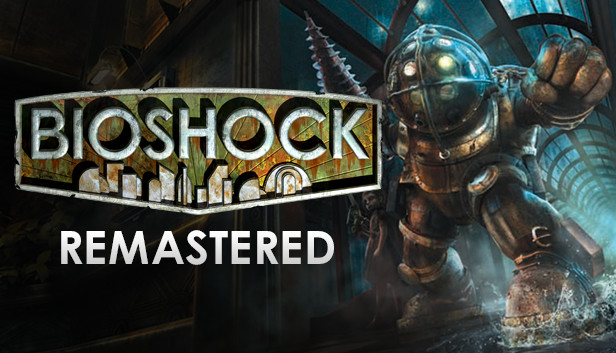
The Complete Lore of Rapture: BioShock, BioShock 2, and the Burial at Sea Connection to Columbia
Every great BioShock twist starts the same way: someone hands you a phrase, a slogan, a sales pitch, and lets you walk the rest of the way into the trap yourself. Andrew Ryan sold Rapture as a city where genius would finally be free of parasites. Zachary Hale Comstock sold Columbia as America’s true, unsullied soul, lifted bodily into the clouds. Both men built a paradise on the backs of people they refused to count as people, and both paradises collapsed into war because of it. That is not a coincidence, and by the time you have followed the threads from the bottom of the Atlantic to the edge of the sky, it stops looking like one.
This is our complete breakdown of Rapture’s lore across BioShock (2007) and BioShock 2 (2010), including exactly how BioShock Infinite: Burial at Sea Episodes One and Two reach down through the ocean floor and stitch Rapture’s story directly into Columbia’s. We are covering Andrew Ryan’s founding philosophy, the ADAM economy that poisoned it, Frank Fontaine’s decade-long con, Sofia Lamb’s answer to Ryan’s failure, and the exact mechanism by which a floating city in 1912 and a sunken one in 1958 turn out to be part of the same argument about human nature. Columbia’s own founding, the Founders-versus-Vox-Populi war, and Elizabeth’s full arc get the dedicated deep-dive they deserve in a companion piece we are building right alongside this one, so consider this the Rapture half of a story that was never really two stories to begin with.
⚠️ Full Spoiler Warning ⚠️ This article covers the complete plots of BioShock, BioShock 2, BioShock Infinite, and both episodes of Burial at Sea, including how each one ends. If any of these are still on your backlog, this is very much a piece to bookmark and come back to after the credits roll.
🌊 Quick Facts Before We Start
- Developers, BioShock (2007) by Irrational Games with 2K Australia (Irrational briefly operated under the name 2K Boston from 2007 to 2010 before reverting), BioShock 2 (2010) by 2K Marin, BioShock Infinite (2013) and both Burial at Sea episodes by Irrational Games
- Publisher, 2K Games
- Releases, BioShock (August 2007), BioShock 2 (February 2010), BioShock Infinite (March 2013), Burial at Sea Episode One (November 2013), Burial at Sea Episode Two (March 2014)
- Settings, Rapture, an underwater city in the North Atlantic founded in 1946, visited in 1960 (BioShock) and 1968 (BioShock 2); Columbia, a floating city that seceded from the United States in 1902, visited beginning July 1912 (BioShock Infinite) and revisited via Rapture on New Year’s Eve 1958 (Burial at Sea)
- Founders, Andrew Ryan (Rapture, objectivist individualism) and Zachary Hale Comstock (Columbia, American exceptionalism and religious prophecy)
- The connective tissue, Burial at Sea Episodes One and Two, which send an alternate Booker DeWitt and a mortal, powerless Elizabeth into Rapture during its final days and directly set up the opening minutes of the original BioShock
🏙️ Rapture: A City Where the Artist Would Not Fear the Censor
Rapture was never a secret hideout in the way pop culture usually imagines underwater cities. It was a statement. Industrialist Andrew Ryan, disillusioned by what he saw as the West’s slide into collectivism, government overreach, and mediocrity, began construction on the city in 1946 at a remote spot in the North Atlantic, recruiting the era’s sharpest scientists, artists, and businessmen with a single pitch: come somewhere no government, church, or society of small men could ever tell them what to build, paint, or believe. Thousands emigrated during what surface newspapers quietly called “the Vanishing,” and for a while, Rapture worked exactly as advertised. Ryan’s own creed, quoted on plaques and murals across the city, still frames every plot point that follows it: “A man chooses, a slave obeys.”
The cracks were there from the start, they just did not look like cracks yet. Ryan’s laissez-faire philosophy meant Rapture had no safety net once the initial construction boom ended, and out-of-work laborers were left to fend for themselves in slums like Pauper’s Drop. Among the professionals Ryan recruited was psychiatrist Sofia Lamb, brought in to help citizens cope with the psychological strain of living permanently underwater. Lamb’s utilitarian, collectivist worldview put her at odds with Ryan almost immediately, and their public philosophical rivalry, individual genius against the good of the collective, ends up being the single argument the entire Rapture saga keeps restaging with different characters standing in for each side.
🧬 ADAM, Plasmids, and the Rise of Little Sisters and Big Daddies
The thing that eventually poisoned Ryan’s utopia arrived almost by accident. Around 1949, geneticist Dr. Brigid Tenenbaum noticed that a war veteran with a previously paralyzed hand had regained full use of it after being bitten by a strange deep-sea slug. Investigating further, she discovered the slugs secreted a stem-cell-like substance capable of rewriting human DNA on the fly, curing injuries and diseases and eventually letting people rewire their own bodies for entirely new abilities. Tenenbaum called it ADAM, and she needed money to scale up her research, money that came from a smuggler and black-marketeer named Frank Fontaine.
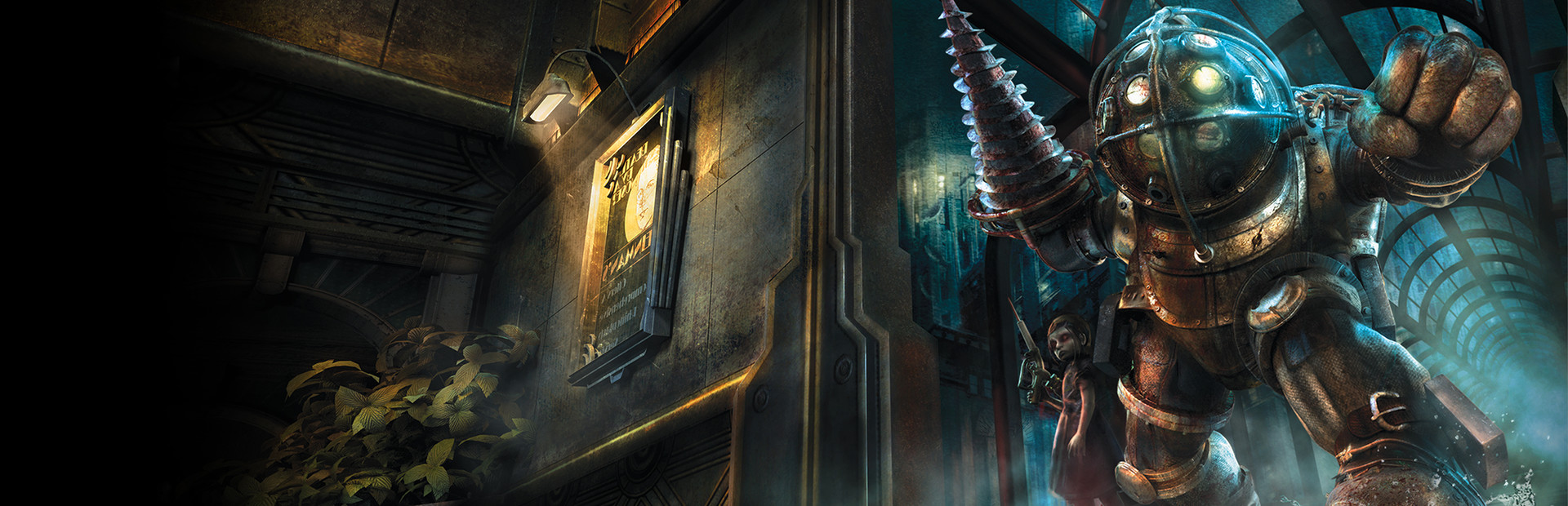
Scaling ADAM production meant scaling slug production, and Fontaine’s solution to that problem is the single darkest supply chain in the entire series. Researchers found that implanting a modified slug directly into a young girl multiplied her ADAM output twenty to thirtyfold, and Fontaine used a chain of “Little Sister orphanages,” marketed to Rapture’s poor as charity, to source the children. The result was the Little Sister, a conditioned child sent out to harvest ADAM from corpses, and her Big Daddy protector, an adult bonded to her through psychological conditioning developed under Dr. Yi Suchong and, later, Dr. Gilbert Alexander, and sealed inside a deep-sea diving suit strong enough to shrug off small-arms fire. Meanwhile, Suchong repackaged ADAM’s more marketable side effects as Plasmids and Gene Tonics, consumer-grade genetic modifications sold across the city from vending machines called Gatherer’s Gardens, letting ordinary Rapture citizens throw fire from their hands or summon a swarm of hornets as casually as buying a soda.
For a few years, ADAM looked like the final proof of everything Ryan believed, unregulated science handing ordinary people god-like power, exactly the kind of unshackled genius Rapture was built to produce. What nobody accounted for was that ADAM, used too heavily or too long, degraded the mind along with the body. Splicers, the plasmid-addicted, physically warped citizens who make up most of BioShock’s enemy roster, are the visible proof that Rapture’s founding bet had a fatal flaw baked into its own miracle substance from day one.
🎨 Fort Frolic, Steinman, and the Splicers Who Ran the Asylum
Ryan and Fontaine get most of the credit for Rapture’s downfall, but a handful of smaller-scale monsters do just as much to show what unlimited ADAM actually does to a person left alone with it for too long. Dr. J.S. Steinman, the plastic surgeon presiding over the Medical Pavilion, starts the game as a respected cosmetic surgeon and ends it convinced that only endless, asymmetrical self-mutilation of his patients counts as true art, a direct product of splicing eating away at his judgment session by session. Sander Cohen, holed up in the nightclub district of Fort Frolic, takes that same ADAM-fueled obsession and turns it homicidal, forcing Jack to track down and kill several of his former proteges so their posed corpses can complete his own demented art installation, a “Quadtych” he insists only Jack has the eye to finish. Botanist Julie Langford, whose Arcadia biodome supplies Rapture’s only breathable air and food, meets a quieter but no less political end, killed by Andrew Ryan himself after their dispute over commercializing Arcadia’s oxygen supply spirals out of control. None of the three change the plot on their own, but together they are the clearest evidence in the entire first game that Rapture’s collapse was not just a Ryan-versus-Fontaine political struggle, it was a citywide psychological breakdown playing out one obsessive, ADAM-soaked professional at a time.
🎭 Frank Fontaine, the Atlas Con, and Rapture’s Civil War
Frank Fontaine did not stay a quiet ADAM financier for long. He built Fontaine Futuristics into a legitimate industrial empire on top of his smuggling profits, positioning himself as living proof that Rapture rewarded ambition exactly the way Ryan promised it would. Ryan, increasingly convinced Fontaine’s empire was a front for smuggling, fraud, and worse, moved to nationalize Fontaine Futuristics and arrest him directly. In late 1958, as Ryan’s security chief closed in, Fontaine staged his own death in a shootout at his own fishery, and the Rapture Council declared the city’s most dangerous man officially gone.
He was not gone, he was reinventing himself. Fontaine resurfaced almost immediately as Atlas, a folksy, Dublin-accented voice claiming to speak for Rapture’s poor and downtrodden, using the very poorhouses his own supposed collapse had helped fill to recruit followers. By his own later admission, the entire rebellion was his “longest con,” a working-class uprising built purely to hand Fontaine the city Ryan had locked him out of. Atlas’s forces launched coordinated attacks through the final weeks of 1958, culminating in the New Year’s Eve riots and the bombing of the Kashmir Restaurant, the spark that formally ignites Rapture’s Civil War. Ryan answered with martial law, mass imprisonment, and eventually pheromone-laced Plasmids designed to strip his own citizens of the free will he claimed to prize above everything else, an irony the game never lets you forget. By the time a plane crashes near a lighthouse in 1960 and a stranger named Jack climbs down into what is left of Rapture, the city Ryan built to escape control has been trying to control its own population by force for over a year.
🔫 BioShock (2007): Would You Kindly, and the Fall of Ryan and Fontaine
BioShock’s entire opening hours run on a lie you do not find out you are living inside until it is almost too late. Jack survives a 1960 plane crash near a lighthouse, descends into Rapture by bathysphere, and is guided over the radio by Atlas, who claims to need help rescuing his trapped wife and son from Ryan’s forces. Every one of Atlas’s requests lands with unusual force, and there is a simple, horrifying reason why: Jack has been genetically conditioned since infancy to obey any instruction that begins with the phrase “Would you kindly.” He does not notice the pattern because he was never meant to.
The reveal, delivered by Andrew Ryan himself moments before Jack is forced to beat him to death with a golf club, recontextualizes the entire game that came before it. Jack is not a random survivor, he is Ryan’s own illegitimate son, smuggled out of Rapture as a newborn, artificially aged, and conditioned by Fontaine specifically to be walked into Rapture Central Control and used as a living weapon against his own father. Ryan’s final act, forcing Jack to kill him rather than let Fontaine claim the victory outright, is the closest the objectivist ever comes to reclaiming a shred of the control he spent his whole life worshipping. Immediately afterward, the man calling himself Atlas drops the accent and the mask, and Frank Fontaine, very much alive, takes direct control of the city. He does not enjoy it for long. Jack, freed from his conditioning with an antidote developed from Suchong’s own research notes, tracks Fontaine to Point Prometheus, where a final overdose of ADAM transforms Fontaine into a lumbering, mutated giant before he is finally brought down for good.
BioShock’s famous multiple endings hinge entirely on how Jack treats the Little Sisters he encounters along the way. Rescue every girl instead of harvesting her for extra ADAM, and Jack leaves Rapture to raise five adopted daughters in a quiet, redeemed life. Harvest them instead, and the game’s closing narration turns openly damning, tracking Jack’s slide from survivor to tyrant in direct proportion to how many Little Sisters he sacrificed along the way.
Brigid Tenenbaum’s own arc quietly runs underneath all of it. The same scientist whose ADAM research made the Little Sister program possible in the first place spends BioShock trying to atone for it, developing the very serum that lets Jack remove the sea slug from a Little Sister without killing her instead of simply harvesting it, and personally guiding him toward the game’s kinder ending if he chooses to save the girls rather than exploit them. It is Tenenbaum’s redemption, as much as Jack’s, that the good ending is really rewarding, and her continued presence, protecting the rescued Little Sisters, is one of the few threads BioShock leaves unambiguously hopeful going into the sequel.
🤿 BioShock 2 (2010): Subject Delta, Sofia Lamb, and the Rapture Family
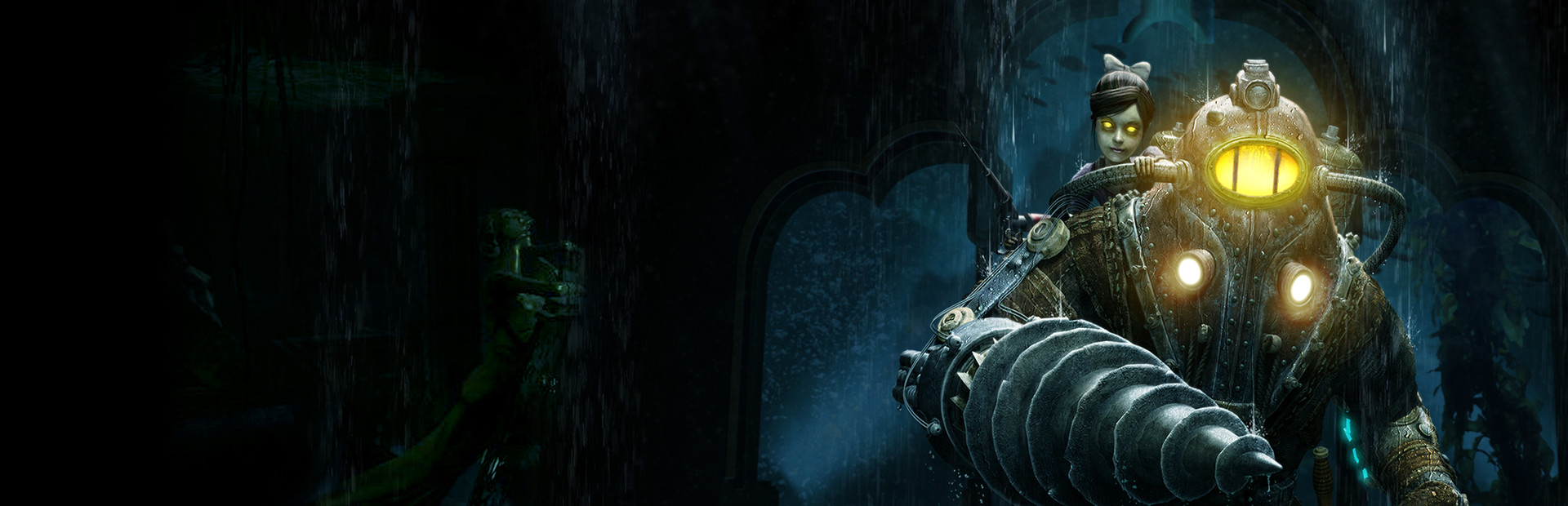
BioShock 2 opens with the boldest structural swing the series ever takes: you spend the entire game inside the diving suit of the exact kind of monster that hunted you in the original. Set in 1968, eight years after Jack’s story, it casts players as Subject Delta, the first successful Alpha Series Big Daddy, once an ordinary diver nicknamed “Johnny Topside” before Ryan had him conditioned and pair-bonded to a Little Sister. The game opens with a flashback to New Year’s Eve 1958, the exact same night Rapture’s Civil War kicked off in the original game’s backstory, where Delta’s Little Sister is revealed to actually be Eleanor Lamb, daughter of psychiatrist Sofia Lamb, who appears out of nowhere, incapacitates Delta with a Hypnotize Plasmid, and forces him to put a pistol to his own head.
Delta does not stay dead. Revived a decade later by a psychic pulse from Eleanor herself, he wakes to find Rapture has a new ruler. With Ryan and Fontaine both gone, Sofia Lamb built the surviving population into the Rapture Family, a collectivist cult first organized during her own psychiatric sessions in the Persephone penal colony, preaching that the individual self, the very thing Ryan built an entire city to protect, is the root of all human suffering. It is the sharpest possible answer to Ryan’s founding philosophy, delivered by the one major character who was arguing against him even before the city fell apart. Because Delta’s pair-bond to Eleanor means he will physically die if he strays too far from her, the entire game becomes a forced march back to a daughter Lamb has spent ten years trying to remake in her own ideological image, layering in supporting figures like the two-faced businessman Augustus Sinclair, the ADAM-ravaged scientist Gilbert Alexander (creator of the Big Sister program), the compromised mole Stanley Poole, and the blacklisted jazz singer turned Rapture Family enforcer Grace Holloway along the way.
One of BioShock 2’s quieter threads, told almost entirely through audio diaries scattered across the ice-cracked district of Dionysus Park, follows a surface-world father named Mark Meltzer who came to Rapture searching for his missing daughter Cindy, only to discover she had already been taken and converted into a Little Sister. Meltzer’s diaries track his slow, horrified realization of what the city actually does to children, and his story runs in parallel to Delta’s own hunt for Eleanor without ever directly crossing paths with it, a smaller, sadder echo of the exact same rescue-or-lose-yourself dilemma the main plot is built around.
👧 Eleanor’s Choice: How BioShock 2 Actually Ends
The endgame plays out at Persephone, the same penal colony where Lamb first built her following, now converted into her personal headquarters. Cornering Delta and a sedated Eleanor, Lamb smothers her own daughter to sever the pair-bond outright, an act that nearly kills Delta through the same biological link that has been driving the entire game. Eleanor, who has spent the whole story secretly watching Delta’s every action through her psychic connection to Rapture’s Little Sisters, revives just long enough to arm herself with Big Sister equipment and fight alongside him, and the two attempt to escape through Sinclair’s own getaway pod as Lamb floods the surrounding chambers.
Delta does not survive the escape. Mortally wounded after the flooding and a forced final confrontation with a captured, forcibly-transformed Sinclair, he makes it only as far as the escape pod itself, where the entire game’s morality system finally pays off. Eleanor, whose personality has been shaped scene by scene by how Delta treated Rapture’s other Little Sisters and key antagonists, makes the final call twice over: whether to save Sofia Lamb from drowning or let her mother go, and what to do with Delta’s dying body. In the best ending, an Eleanor raised on mercy absorbs Delta’s essence and leaves Rapture to spend her life helping others, treating his sacrifice as the foundation of a better philosophy than either of her parents ever offered. In the worst, an Eleanor shaped by cruelty simply extracts what is left of him for her own gain and sets out to dominate the surface instead, proof that Lamb’s dream of erasing the self can curdle into something just as monstrous as Ryan’s dream of glorifying it.
☁️ Columbia in Brief: The City Rapture Never Knew It Had a Twin
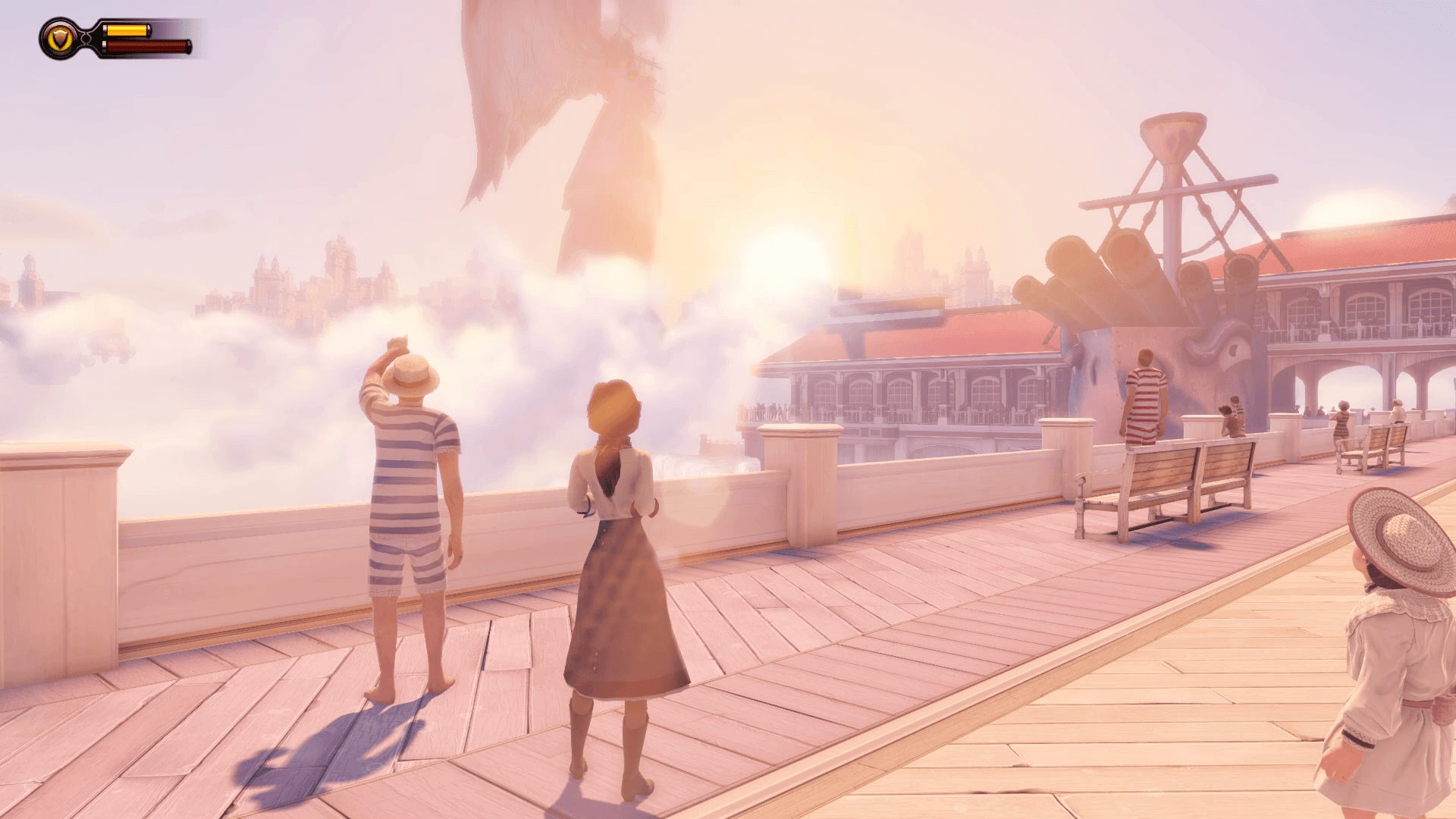
We are giving Columbia’s own founding, faith, and civil war the full deep-dive treatment it deserves in a dedicated companion piece, but you cannot understand how Burial at Sea connects the two cities without the short version first. Columbia began in 1893 as an official United States government project, a literal flying showcase of American engineering and exceptionalism, kept aloft by physicist Rosalind Lutece’s discovery of quantum-levitating “Lutece Particles.” It toured the world as a propaganda triumph until 1901, when Columbia’s own forces opened fire on civilians during the Boxer Rebellion without authorization from Washington. The resulting international backlash led the US government to disavow the city outright, and on July 6, 1902, Columbia formally seceded from the Union and vanished into the clouds under the leadership of Zachary Hale Comstock, a self-styled prophet who rebuilt it as a white-supremacist theocracy built around the idea that mainland America itself had become “the Sodom Below.”
BioShock Infinite picks up on July 6, 1912, exactly ten years after that secession, as Comstock’s oppressed underclass, organized into the Vox Populi under Daisy Fitzroy, finally reaches its breaking point. Comstock’s own story turns out to be inseparable from Booker DeWitt’s, but that is a rabbit hole this piece is deliberately not chasing to the bottom, our companion Columbia and BioShock Infinite lore deep-dive is where that thread gets pulled all the way through.
🔗 Two Cities, One Blueprint: How Rapture and Columbia Actually Connect
Strip away the ocean and the clouds, and Rapture and Columbia are built from the same architectural plan. Both are secessionist utopias founded by a single visionary who wanted total independence from a government he saw as corrupt, Ryan fleeing collectivism and Comstock fleeing a sinful, mongrelized mainland. Both sell that independence on the backs of an underclass they refuse to treat as fully human, Rapture’s Little Sisters and impoverished dockworkers, Columbia’s non-white laborers penned into Finkton. And both founders are eventually undone by a rebellion built from the very people their philosophy discarded, Fontaine’s Atlas persona in Rapture, Fitzroy’s Vox Populi in Columbia.
Some of the overlap is not just thematic, it is literal engineering. Rapture’s ADAM and Plasmids and Columbia’s Salts and Vigors are functionally identical gene-splicing technology sold through near-identical vending machines under different branding for two very different markets. Burial at Sea Episode Two goes further and confirms this is not coincidence: Rapture’s Dr. Yi Suchong and Columbia’s industrialist Jeremiah Fink secretly traded research with each other across universes, co-developing both the Big Daddy suit and Elizabeth’s own captor, the mechanical guardian Songbird, from the same underlying engineering. And running underneath all of it is Rosalind and Robert Lutece’s dimension-crossing technology, the literal Tears and Lutece Devices that make it possible for a private investigator in Rapture to actually be an alternate Comstock, and for a Rapture scientist’s lab equipment to open a direct channel into Columbia’s sky.
Even the two cities’ favorite lie about themselves is the same lie. Fontaine built his entire ADAM supply chain on the “Little Sister’s Orphanage,” a fake charity pitched to Rapture’s poor as a place that would care for their daughters. Comstock, half a world of dimensions away, marketed a stolen infant as the “Lamb of Columbia,” a living prophecy dressed up as divine gift rather than kidnapping. Both cities, in other words, needed a child positioned as an object of public salvation to keep their populations compliant, and both men were lying about what that actually meant for the child at the center of it.
🕵️ Burial at Sea Episode One: A Different Booker, the Same Old Sin
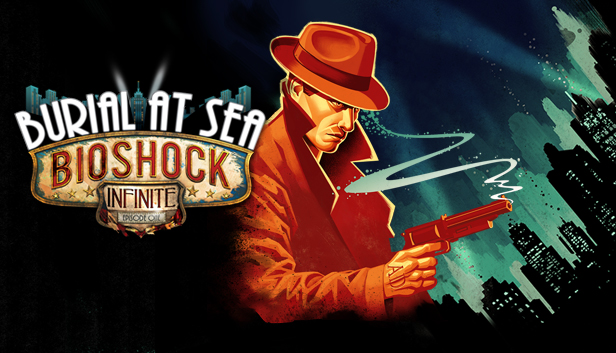
Burial at Sea Episode One drops players into a version of Rapture rebuilt as film noir, on December 31, 1958, the exact night Fontaine’s Civil War is about to erupt into the open. This Booker DeWitt is a private investigator, not a debt-ridden Pinkerton, and he is hired by a version of Elizabeth, arriving from beyond this universe with memories of everything that happened in the main game, to track down a missing girl named Sally. A tip from the artist Sander Cohen leads them to the flooded ruins of Fontaine’s Department Store, where Booker finds Sally alive but already converted into a Little Sister.
That discovery cracks the case wide open in a direction neither Booker nor the player sees coming. The shock of finding Sally triggers Booker’s buried memories, and he realizes he is not really Booker DeWitt at all. He is a version of Zachary Hale Comstock, from a timeline where his attempt, with the Luteces’ help, to steal an alternate universe’s infant Anna DeWitt went catastrophically wrong and the child was killed in the process. Consumed by guilt, that Comstock had the Luteces wipe his memory and exile him to Rapture, where he quietly rebuilt a life as a private eye with no idea what he had done or who he used to be. Elizabeth, who came looking for exactly this confession, refuses to offer him any forgiveness for it. Before he can say much else, Sally’s Big Daddy protector drills him through from behind, and Episode One ends with Comstock dead and Elizabeth’s revenge apparently complete, except it very much is not.
🗝️ Burial at Sea Episode Two: Elizabeth’s Last Trip Down
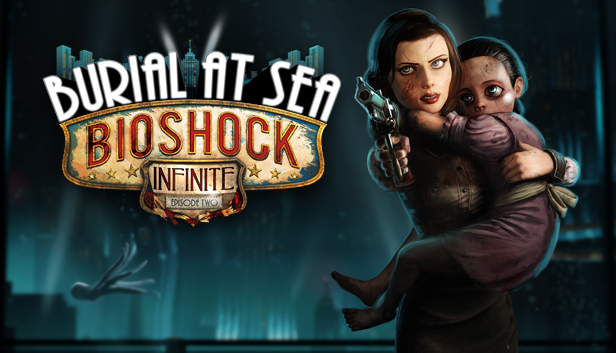
Episode Two hands players Elizabeth herself for the first and only time in the series, and immediately strips away everything that made her powerful. She wakes captured, alongside Sally, by Atlas, who is of course Frank Fontaine wearing his revolutionary mask years before the events of the original BioShock. Finding her own corpse nearby confirms what the Luteces warned her about: dying in this universe collapsed every other version of herself across the multiverse, and she is now permanently mortal, stripped of her tear-opening powers and driven by guilt over the mess her revenge scheme in Episode One actually made.
Trying to save Sally and undo her own damage, Elizabeth turns to Suchong’s lab, where a Lutece Device opens a direct channel to Columbia itself, letting her retrieve a Lutece Particle to raise the flooded department store out of the water. It is here that the Suchong-Fink technology exchange behind the Big Daddy and Songbird comes fully into focus, this is not two writers reusing an idea, it is one piece of shared, cross-dimensional engineering. Atlas eventually captures and tortures Elizabeth for something Suchong hid away called the “Ace in the Hole,” and after Suchong himself is killed, Elizabeth retrieves it herself, only to discover it is a set of coded documents containing the exact trigger phrase Atlas needs to control his next unwitting weapon: “Would you kindly.”
Elizabeth understands immediately what she has just handed over, and what it means for the plane crash survivor Atlas is about to manipulate his way into using. Having secured Sally’s safety, she makes no attempt to fight back when Atlas turns on her, and he beats her to death with a wrench. In her final moments, she sees the whole future play out at once, Jack’s plane going down, his descent into Rapture, Ryan’s death, the rescue of the Little Sisters, and Fontaine’s own eventual fall. A post-credits scene shows that exact plane sinking toward the lighthouse, the literal opening image of the original BioShock, closing the loop on a story that only makes sense once you know it was never really two separate games’ worth of plot at all.
🌌 The Lighthouse, the Man, and the City: What It All Adds Up To
The Lutece twins spend BioShock Infinite insisting that certain things stay fixed across every version of reality no matter what else changes around them, a man, a lighthouse, a city, a girl who needs saving. Rapture and Columbia are the clearest proof the series ever offers that the theory extends past physics and into storytelling itself. Ryan and Comstock are the same failure wearing different ideology, individualism curdled into tyranny in one city, exceptionalism curdled into tyranny in the other. Fontaine’s Atlas and Fitzroy’s Vox Populi are the same uprising wearing different accents. And Jack and Booker are the same shape of man, handed a phrase he cannot resist and a debt someone else designed him to pay off without his consent.
What makes Burial at Sea more than fan service is that it does not just gesture at the parallel, it physically wires the two cities together, a Rapture scientist’s device opening onto a Columbia sky, a mortal Elizabeth dying in a place she was never supposed to visit so that a man she never met could eventually save a city she is not even from. Rapture asked whether a city could survive on pure individual genius with no one accountable to anyone else. Columbia asked whether a city could survive on pure collective purity with no one allowed to be anyone else. Both answers turn out to be the same answer, delivered from opposite ends of the sky and the sea.
❓ Quick Questions About BioShock’s Lore
Do I need to play BioShock Infinite to understand BioShock and BioShock 2?
No. BioShock and BioShock 2 tell a complete, self-contained story about Rapture on their own. The connection to Columbia is only made explicit through the Burial at Sea DLC, which is technically part of BioShock Infinite.
Is the private investigator “Booker DeWitt” in Burial at Sea Episode One the same Booker from the main game?
No. He is an alternate-universe version of Zachary Hale Comstock who lost a version of baby Anna during a botched attempt to take her from another Booker, and had his memory wiped and was exiled to Rapture out of guilt. He only resembles the main game’s Booker because they share the same point of origin before their timelines diverged.
How exactly does Burial at Sea connect to the start of the original BioShock?
Elizabeth retrieves the “Ace in the Hole,” coded documents containing the mind-control phrase “Would you kindly,” and hands it to Atlas (Frank Fontaine) shortly before he kills her. That phrase is what Fontaine later uses to control Jack, whose plane crash near Rapture’s lighthouse is shown in Burial at Sea Episode Two’s post-credits scene.
Are Rapture’s Plasmids and Columbia’s Vigors the same technology?
Functionally, yes. Both are gene-altering substances sold to the public through vending machines, and Burial at Sea Episode Two confirms that Rapture’s Dr. Yi Suchong and Columbia’s Jeremiah Fink shared research across their two cities, which is also how the Big Daddy suit and the Songbird ended up built from the same underlying engineering.
What is the best ending in BioShock 2?
Saving rather than harvesting Little Sisters throughout the game, and sparing key characters where possible, shapes Eleanor into a compassionate person who peacefully absorbs Delta’s essence at the end and leaves Rapture to help others, the version of the ending most often cited as the “good” or canon-leaning outcome.
What order should I experience all of this in?
Release order works best for the twists: BioShock, then BioShock 2, then BioShock Infinite, then Burial at Sea Episode One, then Episode Two. Playing Burial at Sea before the original BioShock spoils Fontaine’s identity and the “Would you kindly” reveal well before either is meant to land.
Final Words
Rapture’s story was always going to end the way it did the moment Andrew Ryan decided a city could run on genius alone, and Sofia Lamb’s answer to that failure ended up just as hungry for control as the philosophy it replaced. What Burial at Sea adds, years after both BioShock and BioShock 2 had already closed the book on Rapture, is proof that none of it was ever fully separate from Columbia’s own rise and fall in the first place. Same lighthouse, same man, same impossible bargain, just wearing a different city’s skyline each time.
If you want the full story of what BioShock Infinite itself gets right about Columbia, Comstock, and Elizabeth’s arc, keep an eye out for our dedicated Columbia lore deep-dive, built to crosslink directly with this piece. Until then, our BioShock 2 Remastered review and our BioShock Infinite review are both already live if you want our full critical take on either game.
Keep the adventure going! Check out our latest posts for more lore, reviews and gaming news here: Gaming
Picture Source: 2K, BioShock Remastered on Steam, 2K, BioShock 2 Remastered on Steam, 2K, BioShock Infinite on Steam, 2K, Burial at Sea Episode One on Steam, 2K, Burial at Sea Episode Two on Steam