
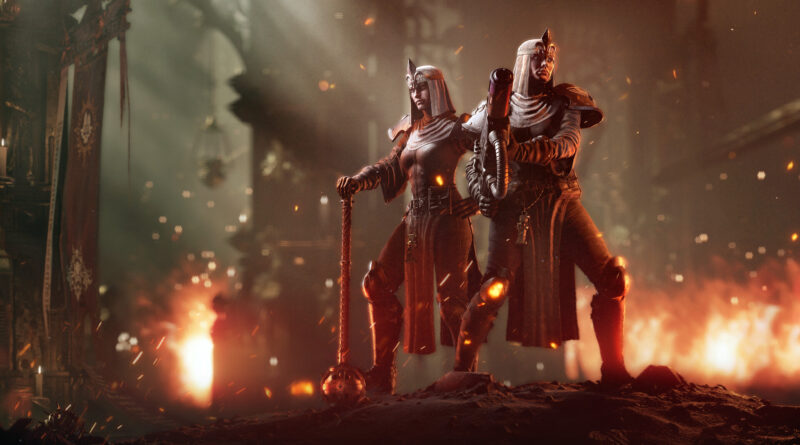
Sisters of Battle Lore Explained: Who Are the Adepta Sororitas, From Goge Vandire to Saint Celestine
The Sisters Novitiate class arrives in Warhammer 40,000: Darktide on December 7, and for many players it will be their first real look at the Imperium’s warrior nuns. Before you take up the bolter and the prayer book, here we have Sisters of Battle lore explained from the beginning: who the Adepta Sororitas are, how a tyrant’s personal bodyguard turned into the Ecclesiarchy’s holy army, what the Decree Passive is, who leads the six Orders Militant, what Acts of Faith are, and why Saint Celestine keeps coming back from the dead.
For the gameplay side of the new class, read our news post Darktide’s Sisters Novitiate Class Arrives December 7, Bringing the Adepta Sororitas to the Hive. If you are completely new to the setting, our explainer on the Imperium of Man and the Emperor is a good place to start.
📜 A Note on Sources: Warhammer 40,000 lore comes from decades of Games Workshop codexes, novels and games, and different editions sometimes contradict each other. We stick to the official background as documented in the codexes, point out where editions disagree, and clearly label anything that is interpretation.
🧾 Quick Facts: The Sisters of Battle at a Glance
- Official name: Adepta Sororitas, also called the Sisterhood or the Daughters of the Emperor
- Part of: the Ecclesiarchy (Adeptus Ministorum), the Imperium’s state church
- Founded: in the 36th millennium, at the end of the Age of Apostasy
- Founder: Saint Alicia Dominica, the woman who beheaded the tyrant Goge Vandire
- Military arm: the Orders Militant, better known as the Sisters of Battle, with six major Orders and many lesser ones
- Current leader: Abbess Morvenn Vahl, who is also a High Lord of Terra
- Most famous member: Saint Celestine, a Living Saint who returns every time she dies
⛪ Who Are the Sisters of Battle? Adepta Sororitas vs. Sisters of Battle
The Adepta Sororitas is an all-female organisation inside the Ecclesiarchy, the vast church that preaches the worship of the God-Emperor across the Imperium. Most fans use “Adepta Sororitas” and “Sisters of Battle” as if they were the same thing, but strictly speaking they are not. The Sisters of Battle are only the Orders Militant, the armed wing of the Sisterhood. It is the largest and best-known part of the organisation, but next to it there are many non-militant Orders made up of nurses, scholars, translators and advisers.
The Sisters of Battle are the Ecclesiarchy’s own army. They fight Wars of Faith, guard shrines and holy relics, and hunt down heresy wherever it hides, including inside the Imperium’s own institutions. Because their mission overlaps so much with the Inquisition’s hunt for heretics and witches, the Orders Militant also serve as the Chamber Militant of the Ordo Hereticus. When a Witch Hunter Inquisitor needs soldiers, the Sisters are the first choice.
Unlike Space Marines, Battle Sisters are not genetically engineered super soldiers. They are ordinary humans, usually orphans raised in the Schola Progenium, who have been trained to the peak of human ability and armed with some of the Imperium’s best equipment. What sets them apart is faith, and in the 41st millennium, faith can be a weapon.
🩸 The Age of Apostasy and Goge Vandire’s Reign of Blood
To understand the Sisters, you have to go back to the darkest chapter in the Imperium’s history after the Horus Heresy: the Age of Apostasy in the 36th millennium. For centuries the Ecclesiarchy and the Administratum, the Imperium’s giant bureaucracy, had fought over who really ruled humanity. The church raised crushing tithes to build ever bigger palaces and monuments, crushed revolts with its own armies, the Frateris Templar, and executed anyone who resisted as a heretic. At the same time, warp storms cut off huge regions of the galaxy.
Into this chaos stepped Goge Vandire, the 361st High Lord of the Administratum. He staged a coup against the Ecclesiarch, had him declared a heretic and shot, and took over the Ecclesiarchy himself. For the first time, one man controlled both the Imperium’s bureaucracy and its church. Vandire was a paranoid, sadistic madman who saw traitors everywhere, tortured prisoners personally and ordered atrocities against entire worlds. His tyranny, remembered as the Reign of Blood, lasted around seventy years.
👰 From Daughters of the Emperor to Brides of the Emperor
Vandire’s spies told him about a small cult on the remote agri world of San Leor: the Daughters of the Emperor, a sect of perhaps only five hundred women who devoted their lives to worshipping the Emperor and to studying the arts of war. Vandire wanted them for himself and travelled to San Leor in person, but the Daughters barred their temple gates and refused to recognise his authority.
Vandire had prepared a trick. Inside the temple, he ordered one of his own soldiers to shoot him. The shot hit him in the chest, there was a blinding flash, and Vandire stood unharmed. The Daughters took it as proof that the Emperor protected him and swore allegiance on the spot. In truth, he was wearing a Rosarius, a hidden personal force field generator. Vandire renamed the cult the Brides of the Emperor and made them his personal bodyguard. They became his most loyal and most feared servants, and by the end of his reign they numbered in the thousands.
⚔️ Alicia Dominica and the Fall of Vandire
Vandire’s downfall began on the world of Dimmamar, where a preacher named Sebastian Thor denounced him as a traitor. Thor’s movement, the Confederation of Light, spread from world to world, and a fleet sent to destroy it was swallowed by a warp storm. Space Marine Chapters and the Adeptus Mechanicus turned against Vandire, and eventually their forces besieged him in the Ecclesiarchal Palace on Terra, where the Brides of the Emperor defended him to the last.
The end came from within. A small group of Adeptus Custodes, the Emperor’s personal guardians, slipped into the palace and tried to convince the Brides that they were serving evil. When words failed, the Custodian Longinus led the Brides’ leader, Alicia Dominica, and five of her companions, Katherine, Silvana, Lucia, Mina and Arabella, through secret tunnels to the Golden Throne itself. What happened before the Emperor has never been recorded. But when the six women returned, they renounced the name Brides, took back the name Daughters of the Emperor, marched into Vandire’s throne room and condemned him. The words engraved on Dominica’s sarcophagus begin with “You have committed the ultimate heresy.” Then she cut off his head.
📜 What Is the Decree Passive?
Vandire’s death officially ended the Age of Apostasy. Sebastian Thor was put on trial, found innocent and named Ecclesiarch, and the High Lords of Terra moved to make sure the church could never again build an army of its own. The result was the Decree Passive, which forced the Ecclesiarchy to disband the Frateris Templar and its fleets.
In the classic version of the lore, introduced with the 1997 Codex: Sisters of Battle, the decree forbade the Ecclesiarchy from keeping “men under arms”. Thor argued that an all-female order did not fall under that wording, so the Daughters of the Emperor were not disbanded but turned into the Adepta Sororitas, a force meant to keep the church pure as much as to defend it. Many fans call this the most famous loophole in Warhammer 40,000. Newer codex material puts far less weight on the wordplay and presents the Sisters more as defenders of the faith than as a standing army, so how literally you take the loophole depends on which edition you read.
Dominica formally founded the Sisterhood under Thor and became its first leader. Its forces were split between two great Convents, the Convent Prioris and the Convent Sanctorum, one on Terra and one on the shrine world Ophelia VII. Which Convent sits where has actually been swapped between editions, which is a nice example of how messy 40K continuity can be.
🌹 The Six Orders Militant and Their Founding Saints
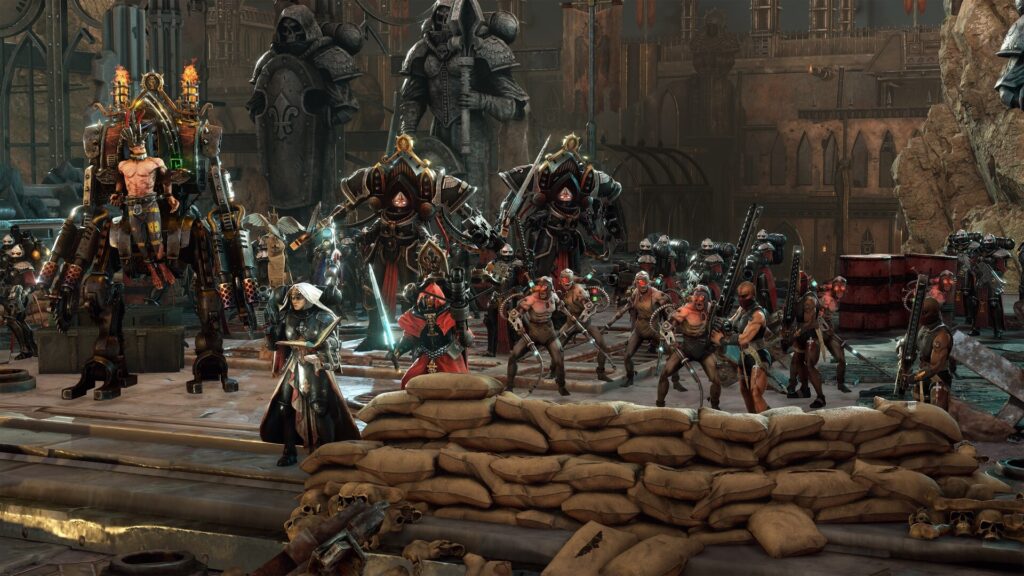
The Sisters of Battle in Warhammer 40,000: Battlesector, which added them as a playable faction in 2022.
As the Sisterhood grew, Ecclesiarch Alexis XXII, Thor’s successor, divided the Orders Militant into four Orders in 378.M36. About two and a half thousand years later, in 878.M38, Ecclesiarch Deacis VI founded two more to honour the last two companions who had stood before the Golden Throne. Each of the six major Orders is tied to one of those six women:
- Order of the Ebon Chalice: Alicia Dominica’s own Order and the oldest of them all. Its symbol, a flaming chalice, refers to the secret knowledge she received before the Emperor, and the Order guards the relic known as the Grail of Ages.
- Order of Our Martyred Lady: originally the Order of the Fiery Heart, founded by Saint Katherine. It was renamed after her murder.
- Order of the Argent Shroud: linked to Saint Silvana.
- Order of the Valorous Heart: linked to Saint Lucia.
- Order of the Bloody Rose: founded in honour of Saint Mina.
- Order of the Sacred Rose: founded in honour of Saint Arabella.
Over the millennia, these major Orders have spawned countless smaller garrisons that grew into independent Lesser Orders Militant. Alicia Dominica herself led the Sisterhood for centuries and was declared a Living Saint before she fell during the Scourging of Frideswide’s World in 650.M36. According to the codex, she survived hundreds of wounds before a single lasgun shot found a gap in her armour and pierced her heart.
🔥 Saint Katherine and the Order of Our Martyred Lady
The Order of Our Martyred Lady is probably the best-known Order today, mostly because it is Games Workshop’s showcase army with black armour and red robes. Its founder, Saint Katherine, was Dominica’s fiery second-in-command and led her Order through countless Wars of Faith. She was eventually murdered by the witch-cult of Mnestteus, and her grieving Sisters renamed their Order in her honour.
Since then, the Order has developed a cult of martyrdom that goes further than any other: dying for the Emperor is seen as the purest fate a Sister can hope for, and outsiders sometimes find them almost suicidal. Katherine’s remains are carried into battle as a holy relic. According to the Order’s traditions, Katherine’s hair turned white when she stood before the Golden Throne, and Sisters of the Order dye their hair white in her memory.
📚 Not Just Warriors: The Non-Militant Orders
The Sisters of Battle get all the attention, but the Adepta Sororitas has hundreds of non-militant Orders. The three best known are:
- Orders Hospitaller: surgeons, physicians and nurses who run hospitals and serve with the Imperium’s armies.
- Orders Dialogus: linguists and scholars who translate the countless dialects of the Imperium, and sometimes alien languages, often serving in an Inquisitor’s retinue.
- Orders Famulous: advisers and stewards placed in noble households to keep the Imperium’s elites loyal and watch for disloyalty from the inside.
Sisters can move between Orders. A Battle Sister who is too badly injured or too old to fight can continue her service in one of the non-militant Orders.
🛡️ Ranks, Armour and the Holy Trinity of Weapons
The Sisterhood is led by the Abbess. Below her, Prioresses run the Convents, and each Order is commanded by a Canoness Superior, with further Canonesses leading the smaller Preceptories, Commanderies and Missions. On the battlefield you will meet Palatines as officers, Sisters Superior as squad leaders, ordinary Battle Sisters, elite Celestians, jump-pack Seraphim and Zephyrim, heavy-weapon Retributors and close-assault Dominions. Far below the full Sisters are the trainees, including the Novitiates, sisters-in-training who have not yet taken their final place in an Order.
Almost every Sister fights in Sororitas power armour, a lighter suit made for the unenhanced human body. According to the codex, it is crafted by the forges of Mars and is the only lasting legacy of Vandire, who commissioned it for his Brides. Their weapons follow the so-called holy trinity: the bolter, the flamer and the melta gun. Every weapon is blessed in rites that can last for days before a Sister receives it.
Then there are the Sisters Repentia. These are Sisters who have failed in some way, whether through disobedience, curiosity or some other sin. They cast off their armour, shave their heads and throw themselves into the front line with huge Eviscerator chainswords, seeking redemption or a glorious death. A Repentia Superior, also called a Repentia Mistress, drives them on with a Neural Whip. Some of the Sisterhood’s greatest heroes started as Repentia, and Celestine is the most famous example.
✨ What Are Acts of Faith?
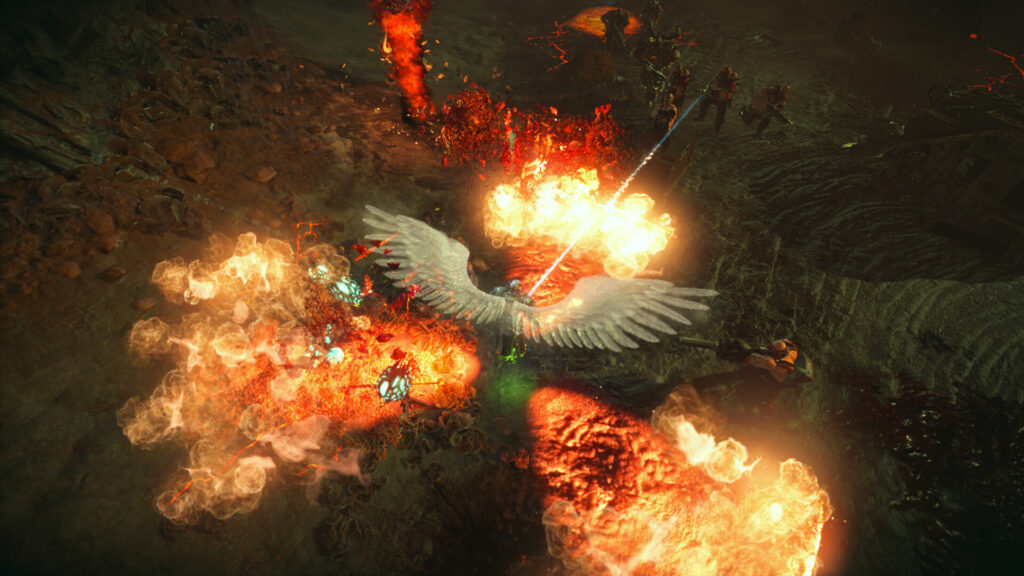
Inquisitor – Martyr’s Sororitas class can turn into a living vessel of the Emperor’s will.
Here is where the Sisters get truly strange. The Sisterhood despises psykers and anything connected to the warp, yet Sisters of Battle regularly perform Acts of Faith: miracles they credit directly to the Emperor. Wounds close, weapons strike with impossible precision, and divine light or fire appears on the battlefield. Their Shield of Faith lets them resist or even deny enemy psychic powers.
Whether these miracles come from the Emperor or from something else entirely is one of the great open questions of the setting. The lore deliberately keeps it vague: even the Necron Cryptek Illuminor Szeras, who dissected human captives to find out how they resisted his anti-psychic technology, could not explain it. Many fans believe the miracles are the Emperor acting through the faith of billions, others see them as an unconscious psychic effect. Both readings are interpretation; the codexes never give a final answer.
😇 Who Is Saint Celestine? The Living Saint Explained
The most extreme form of faith-powered miracle is the Living Saint: a hero of the faith who dies and returns with a holy aura, angelic wings and near-invulnerability. Only a few are confirmed in a millennium, and most come from the Adepta Sororitas. The most famous of all is Saint Celestine.
In the life the Imperium knows best, Celestine was a Sister Repentia of the Order of Our Martyred Lady, fighting heretics during the Palatine Schism. She was thought killed in battle on the world Eurytion, but her Sisters found her body alive and free of wounds. She led the next assault herself and became the figurehead of the Palatine Crusade. On the backwater world Sanctus Lys, she entered a hidden crypt alone and emerged at dawn wearing the golden Armour of Saint Katherine and wielding the Ardent Blade. She was declared a Living Saint and led the Imperium to victory after victory until she was lost on the world of Forrax, where an enemy warlord detonated an atomic device.
But Celestine does not stay dead. She reappeared during Abaddon’s 13th Black Crusade on Cadia, fought the Despoiler himself and raised two fallen Canonesses back to life as her bodyguards, the Geminae Superia. When Cadia fell, she led survivors, including the Archmagos Belisarius Cawl, on the journey that ended at Macragge, where Cawl revived the Primarch Roboute Guilliman. Since then Celestine has died again several times, and each time she has returned. Her return from the dead is canon; whether she is a reincarnation of an even older soul, as some background material hints, remains deliberately mysterious.
👑 Morvenn Vahl and the Sisters in the Era Indomitus
After the Great Rift tore the galaxy in two and Guilliman launched the Indomitus Crusade, the long-vacant office of Abbess was filled by Morvenn Vahl, a young Celestian of the Order of the Argent Shroud. The church’s schemers hoped an inexperienced young commander would be easy to control. They were wrong: Vahl wore her battle armour even in front of the Holy Synod, ignored political ceremony and kept leading her Sisters from the front line. Guilliman later made her a High Lord of Terra, and in battle she wields the Lance of Illumination, a relic spear gifted by the Adeptus Custodes, from inside a Paragon Warsuit.
Under Vahl, the Sisters are fighting more Wars of Faith than ever before, searching for lost Orders and shrine worlds cut off by the Rift. And even the Sisterhood is not immune to corruption. Sisters have fallen to Chaos and to Genestealer Cults, something the Imperium publicly denies. The most infamous case is Miriael Sabathiel, a former Sister Superior of the Order of Our Martyred Lady who turned to Slaanesh and is hunted by her former Sisters.
🎮 Sisters of Battle in Video Games and Darktide’s Sisters Novitiate
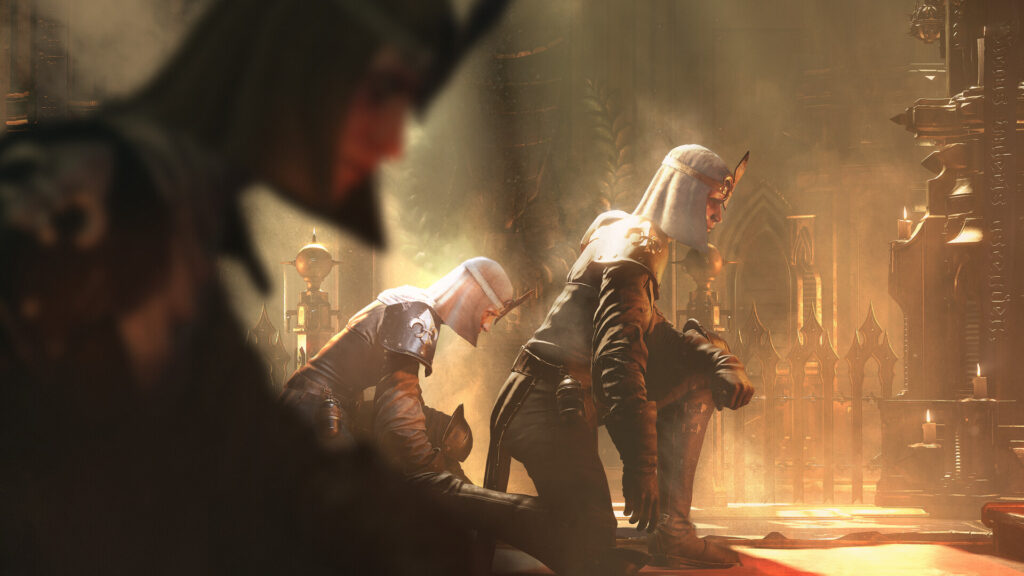
The Sisters Novitiate join Darktide’s fight on Tertium on December 7.
The Sisters have a long history in Warhammer games. Here are the most important appearances:
- Dawn of War: Soulstorm (2008): the Sisters of Battle become a playable army for the first time in the Dawn of War series. For the bigger story of that series, read our Blood Ravens lore explained.
- Inquisitor – Martyr: the Sororitas Class DLC (November 28, 2022) adds an Inquisitor with an Adepta Sororitas background.
- Battlesector and Gladius: both strategy games received Sisters of Battle faction DLC on December 13, 2022.
- Rogue Trader (2023): Owlcat’s CRPG features Sister Argenta, a Battle Sister, as one of its companions.
- Darktide: the Sisters Novitiate Class launches on December 7, 2026.
Why a Novitiate and not a full Battle Sister? It fits the lore. Darktide’s Strike Team is made up of convicts, rejects and expendables fighting in the hive city of Tertium, and a fully ordained Sister of an Order Militant would hardly be assigned to such a band. A sister-in-training, still proving her faith, makes much more sense. The class even builds on Sisterhood lore with Acts of Faith powered by a Faith resource, and weapons like the Penitent Eviscerator and a Neural Whip strike that recall the Repentia. Owlcat’s upcoming Warhammer 40,000: Dark Heresy, set in the Inquisition and launching January 28, 2027, could also bring the Ordo Hereticus’ favourite soldiers back into focus, but how big a role they will play has not been revealed.
❓ Quick Questions About the Sisters of Battle
Are the Sisters of Battle and the Adepta Sororitas the same?
Not exactly. The Adepta Sororitas is the whole Sisterhood; the Sisters of Battle are its Orders Militant, the fighting arm.
Who founded the Sisters of Battle?
Alicia Dominica, the leader of Vandire’s Brides of the Emperor, who beheaded him after standing before the Golden Throne.
Why are there only women in the Sisters of Battle?
They grew out of the all-female Daughters of the Emperor. In the classic lore, the Decree Passive banned the church from keeping “men under arms”, and an all-female order slipped through that wording.
Are the Sisters of Battle psykers?
No. They hate psykers, but they perform Acts of Faith, miracles they believe come from the Emperor. What really causes them is left open.
Is Saint Celestine immortal?
In a way. She has died many times and always returned, but nothing in the lore says she can never truly die.
Who leads the Sisters of Battle today?
Abbess Morvenn Vahl, a former Celestian of the Order of the Argent Shroud and a High Lord of Terra.
Final Words
The Sisters of Battle were born from one of the Imperium’s worst betrayals: a tyrant’s private army that turned on its master after standing before the Emperor himself. Since then they have become the burning heart of the Imperial faith, warriors with no genetic enhancements, only armour, fire and an unshakable belief that sometimes produces real miracles. Whether you join them as a Novitiate in Darktide on December 7 or simply want to understand why they keep showing up in every 40K game, now you know where they come from. Want more Warhammer lore? Read our Imperium of Man explained or our Blood Ravens lore explained next.
Keep the adventure going! Check out more Gaming News on Gamersuniverse.
Picture Source: Fatshark (Steam), Black Lab Games / Slitherine (Steam), NeocoreGames (Steam)