

Dune: Awakening Review: Funcom Perfects Arrakis With a Console Launch and a Full Solo Mode
Dune: Awakening has spent the last fifteen months proving that Frank Herbert’s Arrakis works as a survival game. Today it proves something bigger: that it works alone. September 22 marks Funcom’s console launch on PlayStation 5 and Xbox Series X|S, arriving alongside Update 1.5, the single biggest patch the game has ever received. Between a full single-player mode, the conclusion of the Book One story, and a mountain of quality-of-life changes, this is effectively a second launch, and the version we are reviewing here is the one every new Sleeper, on any platform, will actually play.
Here’s the full breakdown across our five categories (2 points maximum each).
Table of Contents
Dune: Awakening Story – 1.5/2
Good Points: Premise, Intrigue, Book One’s Finale
Premise
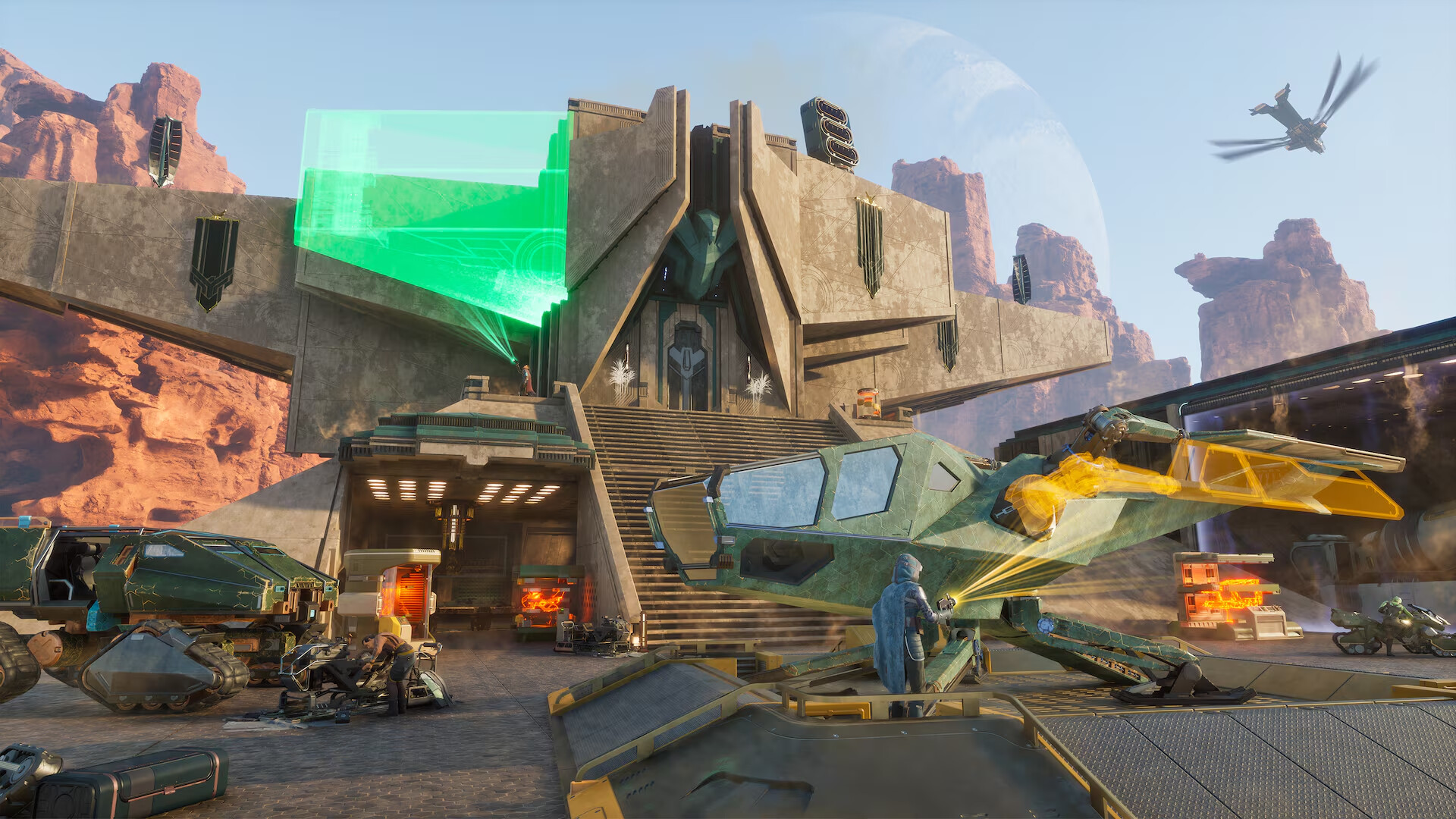
Dune: Awakening tells an alternate-timeline story: Paul Atreides was never born, Duke Leto Atreides survived the Harkonnen assault on Arrakeen, and the Fremen have vanished without a trace. You play the Sleeper, an amnesiac agent of the Bene Gesserit sent to Arrakis to find out what happened to them, all while getting pulled into the grinding cold war between House Atreides and House Harkonnen over the planet’s spice.
A Story Told in Chapters
Since launch, the main quest has grown in free installments: Chapter 2 (September 2025) turned Arrakeen into the scene of a murder mystery, and Chapter 3 (February 2026) pushed the plot into new territory with one of the game’s best story beats to date. With Update 1.5, the Great Convention Part III closes out Book One entirely, and for the first time the full five-act story can be played start to finish in a single run, solo or otherwise.
Where It Falls Short
This is still a survival game’s idea of a story: characters like Duke Leto and Feyd-Rautha Harkonnen make appearances, but the writing exists mostly to justify the next objective marker, and the Bene Gesserit intrigue rarely digs as deep as the source material’s politics. It is a serviceable, occasionally gripping frame for the moment-to-moment loop rather than a reason to play on its own.
Dune: Awakening Gameplay – 1.5/2
Special Praise: Survival Loop, Solo Mode, Combat Overhaul
Survive, Protect, Expand, Control
Dune: Awakening’s core loop is built around four phases: manage thirst and stillsuit integrity, harvest spice under the threat of sandworms, build a base piece by piece, and craft everything from handheld tools to a fully assembled ornithopter. It is dense, patient survival design, closer to Conan Exiles than a shooter, and the systems reward the kind of long-term planning the genre lives on.
A Full Single-Player Mode
This is the headline addition of Update 1.5, and it delivers. Single-player is not a stripped-down offline mode, it is the entire game, every location, every story beat, every reward, playable start to finish without another player in sight. Funcom rebuilt the systems that assumed a live economy to make this work: the Exchange now behaves like a stocked vendor instead of a player market, the Landsraad political endgame simulates the rival Minor Houses so it keeps moving even with nobody else playing, and the weekly Coriolis storm that resets the Deep Desert keeps running on its normal schedule whether or not anyone is around to see it. You choose between three difficulty presets or dive into granular sliders for harvesting rates, sandstorm frequency, item durability, base decay, and more, and you can change your mind at any time.
PvP Is Now a Choice, Not a Tax
Multiplayer has been rebuilt around the same philosophy. Hagga Basin, the starting map, is now fully PvE by default, so critical crafting resources are no longer gated behind fights you did not ask for. The endgame Deep Desert runs as separate PvE and PvP instances on every official server, with the PvP side paying 2.5x the mining and harvesting yield to reward the added risk. If you want the old, fully competitive Arrakis, you can still get it on a self-hosted server.
Combat and Quality of Life
Melee combat has been reworked with a more lenient parry window, clearer enemy tells, and a dash that now lets you pass through enemies to escape a bad position, alongside two new weapons in the Pyrocket launcher and Dual Blades. Funcom has also gone after nearly every way the game used to punish you for playing it over the past year: base upkeep taxes were removed entirely back in February’s Chapter 3 update, and Update 1.5 builds on that with the death penalty dropping from a 5% to a 2% durability loss, destroyed vehicles recoverable for up to 30 days, and a new Base Reconstruction Tool that lets you snapshot an entire base and rebuild it elsewhere, even on another server.
Where It Falls Short
None of this fully escapes the genre’s inherent friction. Water and thirst management, spice hauling, and Landsraad mission grinding are still slow by design, and solo players will feel Arrakis’s biggest set pieces (multi-crew harvester runs, Deep Desert convoys) are still built with a group in mind, even if Funcom has made them possible alone.
Dune: Awakening World – 2/2
Special Praise: Arrakis Itself, Scale, a Year of Expansion
A Planet That Wants You Dead
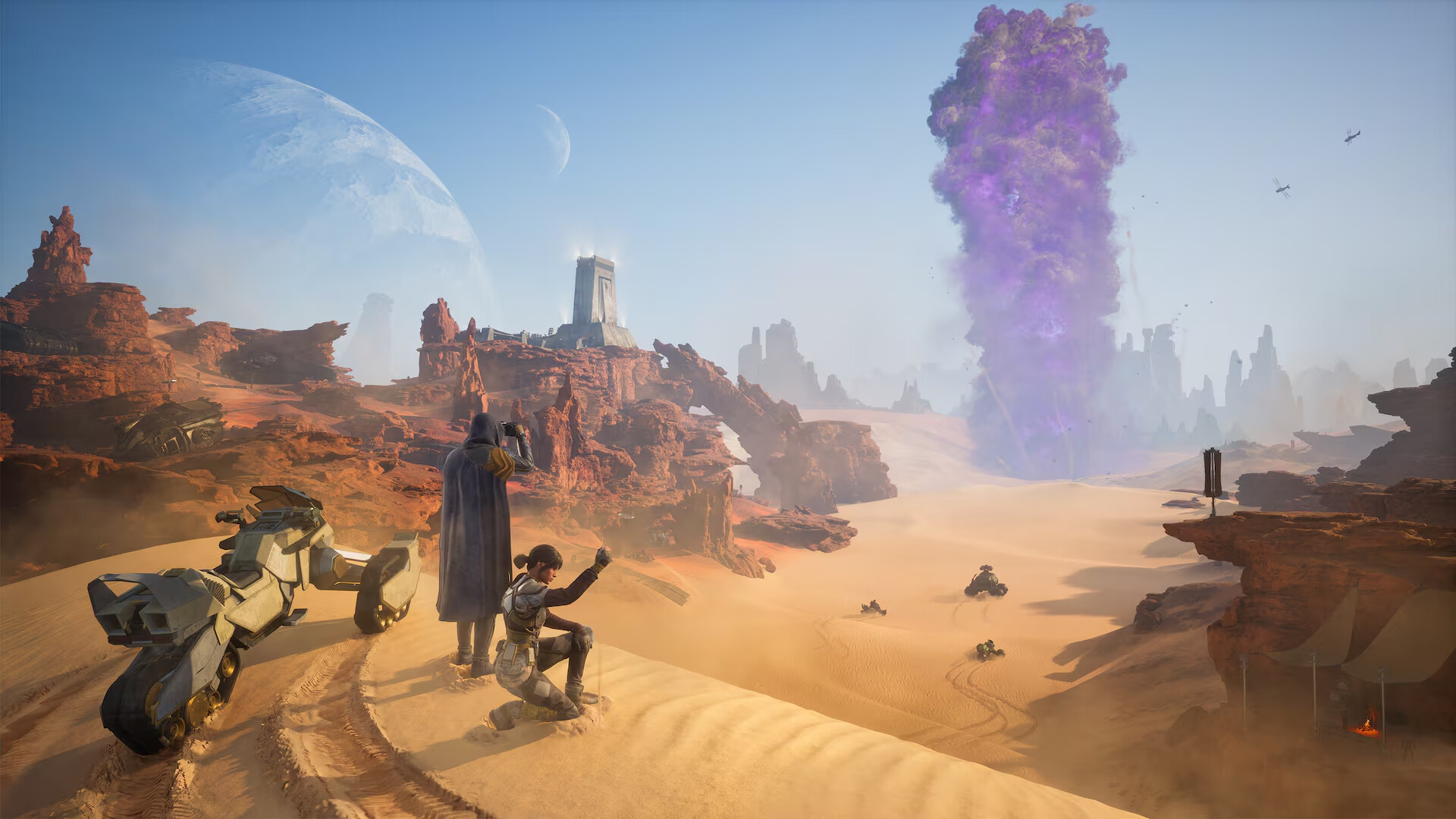
Arrakis remains the real main character. Rolling dunes give way to the shade of hidden Fremen caves and the crowded streets of Arrakeen, all under the constant threat of roaming sandworms and sandstorms that can bury a base in minutes. Chasing shadows to avoid heatstroke, climbing cliffs with the Shigawire hook, and watching a Coriolis storm roll across the horizon before you can outrun it, it is one of the most convincing hostile-planet simulations in the survival genre.
A Year of Growth
Arrakis has grown steadily since launch. Players can now reach Smuggler’s Run, Blushing Caverns, the Broodworks, the Wreck of Tyche, the Old Quarry, the Ruins of Tsimpo, and Wind Pass, along with additional Imperial Testing Stations built around unique boss fights and difficulty that scales for solo or grouped play. Funcom has also confirmed the Polar Cap, an icy biome with its own survival mechanics and storyline, as a free update later this year, plus tie-in cosmetics when Dune: Part Three reaches theaters on December 18.
Where It Falls Short
Arrakis is still, deliberately, a hostile place to look at for long stretches, muted palettes of sand and rock dominate outside of Arrakeen and the Deep Desert’s more alien pockets, and returning players may find the overland map’s early regions a little familiar after a year of repeat visits while waiting for the Polar Cap.
Bugs – 1.5/2
On PC, a year of patches shows. Funcom has run a sustained campaign against item duplication, Solari duping, durability-restore exploits, and undermeshing, and server stability has improved dramatically since the rockier early weeks of 2025. On console, the picture is a little more mixed at launch: our impressions from the PS5 head start were largely smooth, with the PS5 Pro in particular rendering Arrakis at a genuinely impressive clip, but early Xbox Series X coverage has reported occasional visual flicker during cutscenes, textures that can drag their heels streaming in when moving between underground bunkers and the open desert, and resolution dips during dust storms even in Performance mode. None of it is severe enough to block progress, and Funcom has a strong track record of ironing out these launch-week rough edges quickly, but it is enough to cost a point here on day one.
Features of Dune: Awakening – 2/2
How the Systems Work Together / Uniqueness
Engine
Dune: Awakening runs on Unreal Engine 5. Bringing single-player online required real engineering work under the hood: the game was originally built around PostgreSQL, a server-grade database suited to a persistent multiplayer world, and Funcom had to convert single-player saves to a lightweight, serverless SQLite setup to make solo play run smoothly, especially with the added constraint of console memory budgets. The console build also unlocked broader performance work that benefits PC too, including Nanite foliage and far more efficient sandstorm rendering. On PS5, PS5 Pro, and Xbox Series X, players get a choice between a 60fps Performance mode and a 30fps Quality mode, both at dynamic 4K, with PS5 Pro rendering at a higher native resolution in both. Xbox Series S runs Performance mode at a lower dynamic resolution (roughly 720p-1080p) to hold 60fps, the trade-off you would expect from the least powerful console in the lineup.
System Synergy
What makes this update land is how many previously separate systems now visibly support each other:
- Single-player and self-hosted servers share the same deep customization menu, so the difficulty you tune alone is the same one you can hand to a private group.
- Characters, not servers, are now the anchor of your progress: a character can move between official, private, and self-hosted worlds (never back to official, to protect server integrity), with backed-up bases and vehicles following along.
- The reworked Landsraad ties directly into the PvE/PvP split in the Deep Desert, letting the same mission-driven endgame serve solo players, PvE groups, and PvP raiders without forking the content.
- Quality-of-life systems like Base Reconstruction and Vehicle Recovery plug directly into the death and disaster mechanics, so losing a fight to a sandworm no longer means losing hours of progress with it.
DLC Integration Notes
Funcom has kept every paid add-on cosmetic-only since backlash over Lost Harvest’s underwhelming scope and unclear communication in 2025, with new features, locations, and story chapters released for free instead. Lost Harvest ($12.99, September 2025) remains the outlier, a standalone story about a crashed Miner’s Guild harvester with its own cosmetics and the Treadwheel vehicle. Raiders of the Broken Lands (February 2026) and The Water Wars (May 2026) added Smuggler and Water Shipper-themed building sets, and the new Filmic Archive DLC ($9.99, out alongside the console launch) brings looks pulled straight from Dune: Part One and Part Two, including Harkonnen Cataphract and Atreides Hoplite armor, the Caladan Stormcoat, and a 73-piece Sardaukar building set. All of it is optional and skippable. If Funcom ever expands Lost Harvest’s story into something bigger, or once the free Polar Cap update lands later this year, we will cover it here with its own dedicated review and link back to this page.
Gamersuniverse Score:
8.5 out of 10 stars⭐
Dune: Awakening earns its console launch. What could have been a straightforward port instead arrives as the definitive version of the game on every platform: a genuinely complete single-player mode that respects the years of survival design underneath it, a multiplayer experience that no longer forces PvP on anyone, and a year’s worth of quality-of-life work that has quietly sanded down almost everything that used to make Arrakis feel unfair rather than just dangerous.
The story remains a frame rather than a reason to visit on its own, and console players should expect a few launch-week rough edges, but as a survival sandbox built on one of science fiction’s most iconic worlds, Dune: Awakening has never been in better shape, and now anyone can experience it, with friends, with strangers, or entirely alone.
Score Summary
- Story: 1.5/2
- Gameplay: 1.5/2
- World: 2/2
- Bugs: 1.5/2
- Features: 2/2
Total: 8.5/10
Are you jumping into Arrakis solo for the first time, or are you a returning Sleeper checking out Update 1.5? Let us know in the comments.
You can find more reviews here: Reviews
Dune: Awakening
Summary
Dune: Awakening earns its console launch. What could have been a straightforward port instead arrives as the definitive version of the game on every platform: a genuinely complete single-player mode that respects the years of survival design underneath it, a multiplayer experience that no longer forces PvP on anyone, and a year’s worth of quality-of-life work that has quietly sanded down almost everything that used to make Arrakis feel unfair rather than just dangerous.