
Hammerfell Lore Explained: The Redguards, Yokuda and Sentinel Before The Elder Scrolls VI
After eight years of silence, Bethesda has finally given The Elder Scrolls VI a name: The Elder Scrolls VI: Sentinel. Sentinel is not a random word. It is one of the oldest and most powerful cities of Hammerfell, the desert homeland of the Redguards in western Tamriel. If you have only ever met Redguards as merchants in Skyrim or as the Alik’r warriors hunting a fugitive in Whiterun, this Hammerfell lore explained guide covers everything you need before the next journey to Tamriel: the lost continent of Yokuda, the sword-singers, the founding of Sentinel, the Crowns and Forebears, and how the Great War left Hammerfell standing alone against the Thalmor.
The Elder Scrolls tells much of its history through in-game books, and many of those books are written by in-world authors with their own agendas. We stick to what the games and their texts establish, point out where accounts disagree, and clearly label anything that is speculation about Sentinel itself.
⚠️ Spoiler Warning ⚠️ This article covers the stories of The Elder Scrolls Adventures: Redguard, The Elder Scrolls II: Daggerfall, The Elder Scrolls Online and The Elder Scrolls V: Skyrim. There are no spoilers for Sentinel, because Bethesda has not revealed its story yet.
🧾 Quick Facts: Hammerfell at a Glance
- Location: western Tamriel, bordering High Rock to the north, Skyrim to the northeast and Cyrodiil to the southeast
- People: the Redguards, descendants of the Yokudans from the sunken continent of Yokuda
- Heart of the land: the vast Alik’r Desert, with port cities along the Iliac Bay and the southern coast
- Older names: Hegathe, the Deathland and Volenfell
- Key city: Sentinel, founded by Grandee Yaghoub and seat of the High King since the Interregnum
- Factions: the traditionalist Crowns, the cosmopolitan Forebears and the newer Lhotunics
- Visited in: Arena, Daggerfall, Redguard and The Elder Scrolls Online
- Current status: an independent kingdom since leaving the Empire after the Great War
📜 What Bethesda Revealed About The Elder Scrolls VI: Sentinel
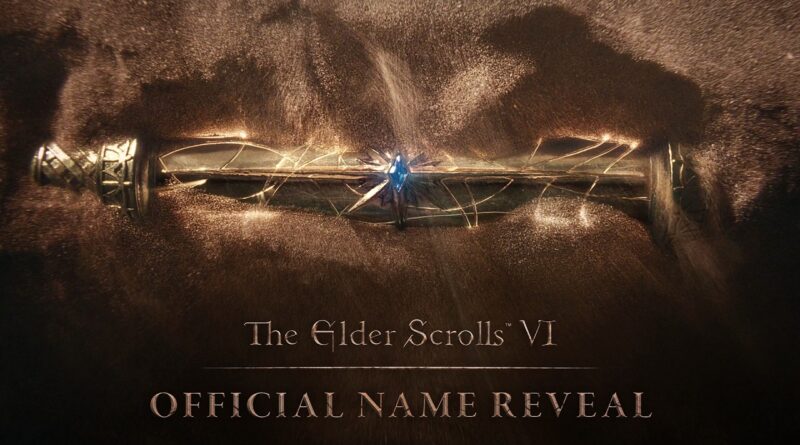
The name arrived on November 3, 2026, as part of Bethesda Game Studios’ 40th anniversary celebrations, in a one-minute video called The Elder Scrolls VI: Official Name Reveal. Wind sweeps across a sand dune and uncovers an Elder Scroll buried beneath it, glowing with magical energy. The video then shows the new logo and a short inscription, credited to Yazar, Moth Priest to High Queen Iradne of Hammerfell, and dated 4E 206. It opens with the line “The scroll offered only a shimmer, a veil thinly lifted to my eyes.” The rest speaks of a lost future, an undone victory and the sands of time scattered by fate.
That short text is packed with lore. A Moth Priest is one of the few people who can read an Elder Scroll, a High Queen of Hammerfell is a ruler nobody has met before, and 4E 206 is exactly five years after the events of Skyrim, which take place in 4E 201. Bethesda has not yet spelled out the setting in a press release, but the desert, the inscription and the name all point to Hammerfell. Shortly before the reveal, The Verge’s Tom Warren reported that the game is set in Hammerfell and that its story focuses on the history of the Elder Scrolls themselves. There is still no release date and no official platform list, although Microsoft documents from the 2023 FTC case listed the game for PC and Xbox, no earlier than 2026. You can read our full news coverage in The Elder Scrolls VI: Sentinel Is Official.
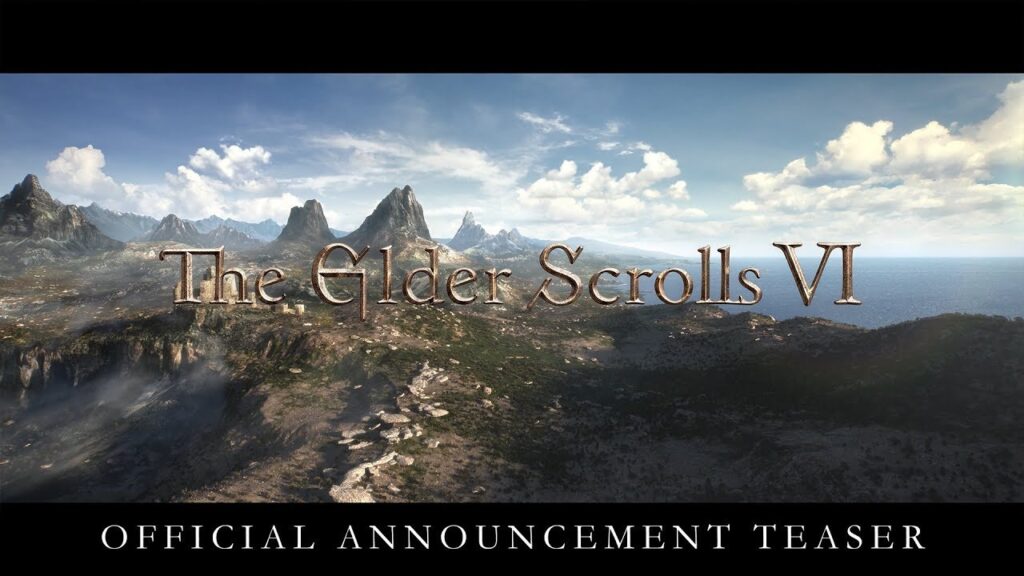
The arid coastline in the 2018 teaser fueled years of Hammerfell theories before the Sentinel name confirmed them.
The clues had been piling up for a long time. The original teaser at Bethesda’s E3 2018 showcase on June 10, 2018, showed a dry coastal landscape. Fans later decoded the employee number in Starfield’s character creator, 190514-2009140512, as the letters SEN-TINEL. In August 2026, Xbox CEO Asha Sharma posted about a live playthrough of “The Elder Scrolls VI” with the subtitle hidden behind eight asterisks, the exact length of the word Sentinel.
🏜️ Where Is Hammerfell? The Deathland Before the Redguards
Hammerfell sits in the west of Tamriel, between High Rock, Skyrim and Cyrodiil, with the Iliac Bay to the northwest and open ocean to the west and south. The great Alik’r Desert forms the heart of the land, but Hammerfell is more varied than its reputation: there are grasslands, beaches, coastal jungles, swamps and the forested Dragontail Mountains. Its cities cling to the coasts, while nomadic tribes wander the interior.
Long before the Redguards, this land had other names. The Aldmer called it Hegathe and the early Nedic peoples called it the Deathland, both meaning roughly the same thing. Ayleid settlements and Nedic cities dotted the region, and in 1E 420 a clan of Dwemer arrived. The Rourken clan refused to accept the alliance between the Dwemer and the Chimer that created Resdayn, the forerunner of Morrowind. Legend says their chieftain threw his mighty hammer, Volendrung, across Tamriel and promised to lead his people wherever it fell. They followed it west and built a capital called Volenfell, the “City of the Hammer”. Like every other Dwemer, they vanished around 1E 700, and their ruins still lie half-buried in the sands of the Alik’r. Many of Hammerfell’s modern cities stand on old Dwemer foundations.
🌊 Yokuda Explained: The Lost Homeland of the Redguards
To understand Hammerfell, you have to start somewhere else entirely. Yokuda was a continent far to the west of Tamriel, a land even more arid than Hammerfell, and the ancestral home of the Redguards. It was ruled by the Na-Totambu, an ancient council of kings, and Yokudan legends tell of a thousand-year war against a race of elves known as the Lefthanded Elves, which the Yokudans eventually won.
Yokuda’s later history was one of near-constant civil war. Out of that chaos grew the martial tradition that defines the Redguards to this day: sword-singing. Poets and mystics turned to the Way of the Sword, and the greatest of these warriors became known as Ansei, the “Saints of the Sword”. The most skilled sword-singers could summon the Shehai, a spirit sword formed from their own will.
When Emperor Hira tried to wipe out the sword-singers, they rebelled in what became known as the War of the Singers. Around 1E 780, the legendary Frandar Hunding led the outnumbered singers to victory at the foot of Hattu Mountain, where he had written the Book of Circles, the Redguards’ great treatise on the art of war. Afterwards, Hunding and his army sailed east toward Tamriel. This was the first of the Ra Gada, the “Warrior Waves”.
Then, around 1E 792, Yokuda sank beneath the sea. Nobody in Tamriel knows exactly why, and the in-game sources offer several explanations:
- A natural disaster: earthquakes were common on Yokuda, and some accounts blame purely natural forces.
- The Hiradirge: legends blame a defeated band of Ansei who used a forbidden sword technique in revenge, a power said to be capable of breaking the very laws of nature.
- Divine punishment: other tales say the Yokudans abandoned their gods and summoned things that should never have been called, until Satakal rose from the sea and pulled the land down.
Even the fate of Yokuda is not fully settled. Some Third Era texts mention ships sailing to Yokuda and treat the continent as if parts of it still exist. Given that the Verge report ties Sentinel’s story to the history of the Elder Scrolls, it is easy to see why fans are wondering whether Yokuda will finally play a role. Speculation: that idea is pure fan theory for now, and Bethesda has said nothing about it.
⚔️ The Ra Gada: How the Redguards Conquered Hammerfell
As Yokuda fell, its survivors fled east. Most of the refugees, including the Na-Totambu ruling class, landed on the island of Herne, while the warriors of the Ra Gada sailed on to the mainland in 1E 808, first landing at Hegathe on the southwest coast. What followed was not a peaceful settlement. The Ra Gada drove out or subjugated the beastfolk, Nedes, Orcs and giant goblins they found, clearing the way for their kings to follow.
Frandar Hunding died fighting the giant goblins, but his son Divad Hunding carried on, drove the goblins out and conquered the Alik’r. Within a few generations, the newcomers had turned the Deathland into their own kingdom. Even so, the Redguards remain the youngest people of Tamriel: every other modern race was already there when the Ra Gada arrived.
Even the names “Redguard” and “Hammerfell” come with two competing explanations. Imperial scholars believe “Redguard” is simply a corrupted pronunciation of “Ra Gada”. Redguard legend tells a far more dramatic story: Hunding won the War of the Singers with his “Hammer and Anvil” strategy, but the final battle was so bloody that the people saw their guardians as red with blood. The singers left Yokuda and named their new land after the hammer that fell and themselves after that blood.
🏰 What Is Sentinel? The City Behind the Elder Scrolls VI Name
Sentinel’s founding story goes back to the Ra Gada. After landing at Hegathe, the warrior-sailors of Grandee Yaghoub sailed north and rounded Cape Shira, becoming the first Ra Gada to discover the Iliac Bay. When a watchman spotted a good harbor, Yaghoub decided to build his city there and named it Sentinel after that watchman. The local port was taken with little resistance, and the locals were put to work building his palace, Samaruik, also called Sentinel Palace, which is described as the oldest and largest Redguard architectural monument.
Sentinel sits on rocky hills above the Iliac Bay, with the Alik’r Desert behind it. Because the land around it is poor for farming, the city became a merchant power instead. Its main street is a huge market running from the harbor to the badlands gate, and nobles from Daggerfall and Wayrest have long visited it for its food, craftsmanship and theater. During the Interregnum of the Second Era, the High King moved his throne from the old capital Hegathe to Sentinel, which by then controlled a third of all trade in the Iliac Bay. Ever since, Sentinel has been the most important city in Hammerfell.
👑 Who Are the Redguards? Crowns, Forebears and the Old Gods
The Redguards are known as the most naturally gifted warriors in Tamriel, but they are far from united. Their politics are shaped by a split that goes back to the Ra Gada:
- The Crowns: descendants of the Na-Totambu, the old Yokudan nobility. They are traditionalist, often wary of outsiders, and still worship the Yokudan gods. Their strongholds lie mostly in southern and inland Hammerfell.
- The Forebears: descendants of the Ra Gada warriors, who see themselves as the first Redguards in Tamriel. They are cosmopolitan traders and largely worship the same pantheon as the Imperials. Sentinel has long been their stronghold.
- The Lhotunics: a newer third faction founded by King Lhotun of Sentinel in the late Third Era, representing a middle ground between the two.
The names Crowns and Forebears date back to the Second Empire, when the two groups formed political parties to help administer the province. Religion is one of their biggest dividing lines. The Yokudan faith centers on Satakal, the serpent god who consumes the world and begins it anew, again and again. Ruptga, better known as Tall Papa, was the first spirit to learn how to survive this cycle and placed the stars in the sky to show others the way. According to the Pocket Guide to the Empire, Tall Papa and his children Hunding, Leki and Ansei are the most popular gods in Hammerfell. Other important figures include Tu’whacca, the god of souls who watches over the Far Shores, and the HoonDing, the “Make Way God” who is said to appear whenever the Redguards need to make way for their people.
🛡️ Hammerfell History: From the Siege of Orsinium to the Tiber War
Hammerfell’s history is a long chain of wars, alliances and betrayals. In the First Era, Sentinel joined Daggerfall and the Yokudan Order of Diagna in the decades-long Siege of Orsinium, which ended with the Orc city razed in 1E 980. King Joile of Daggerfall secretly planned to betray his Redguard allies, and in 1E 973 he invaded Hammerfell, only to be killed at the Bangkorai Pass by the Ansei Makela Leki.
In The Elder Scrolls Online, set in 2E 582, King Fahara’jad of Sentinel is a member of the Daggerfall Covenant alongside High King Emeric of Wayrest and Kurog of Orsinium. ESO is also the best way to see Hammerfell today, with zones such as the Alik’r Desert, Bangkorai, Stros M’Kai, Craglorn and Hew’s Bane.
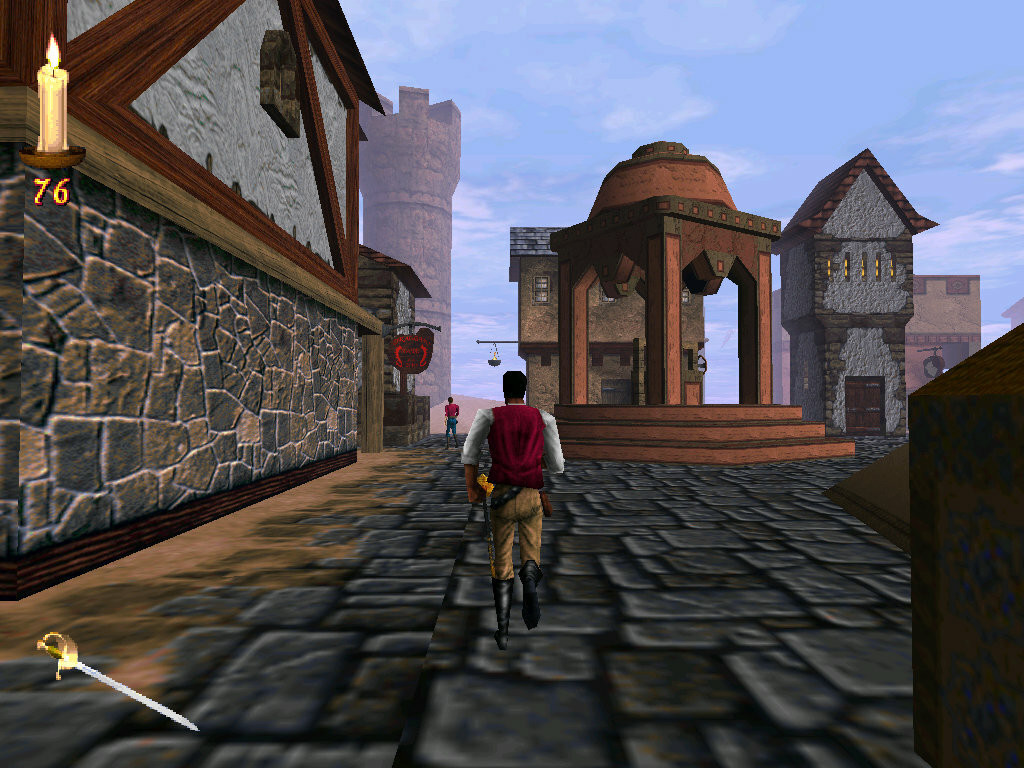
The Elder Scrolls Adventures: Redguard took players to Stros M’Kai during the Imperial conquest of Hammerfell.
The darkest chapter came at the end of the Second Era. When High King Thassad II died in 2E 862, Hammerfell fell into civil war. The Crowns backed his heir, Prince A’tor, while the Forebears seized Sentinel. A’tor’s revenge led to one of the bloodiest massacres in Tamriel’s history, and the Forebears turned to Tiber Septim for help. In 2E 864, the Crowns made their last stand at the island of Stros M’Kai, where they were defeated by Admiral Amiel Richton and Tiber Septim’s dragon ally Nafaalilargus.
This is where The Elder Scrolls Adventures: Redguard (1998) picks up. Its hero, Cyrus, comes to Stros M’Kai to find his missing sister Iszara and is drawn into the fight against Imperial rule alongside the rebels of the Restless League. In the finale, Cyrus confronts Richton aboard a Dwemer airship and kills him with the Soul Sword, a blade holding the soul of Prince A’tor. Afterwards, a new treaty with more favorable terms for the Redguards was signed, with Iszara and the Forebear leader Baron Volag representing their factions. Some texts even suggest that A’tor and Cyrus together were the latest incarnation of the HoonDing.
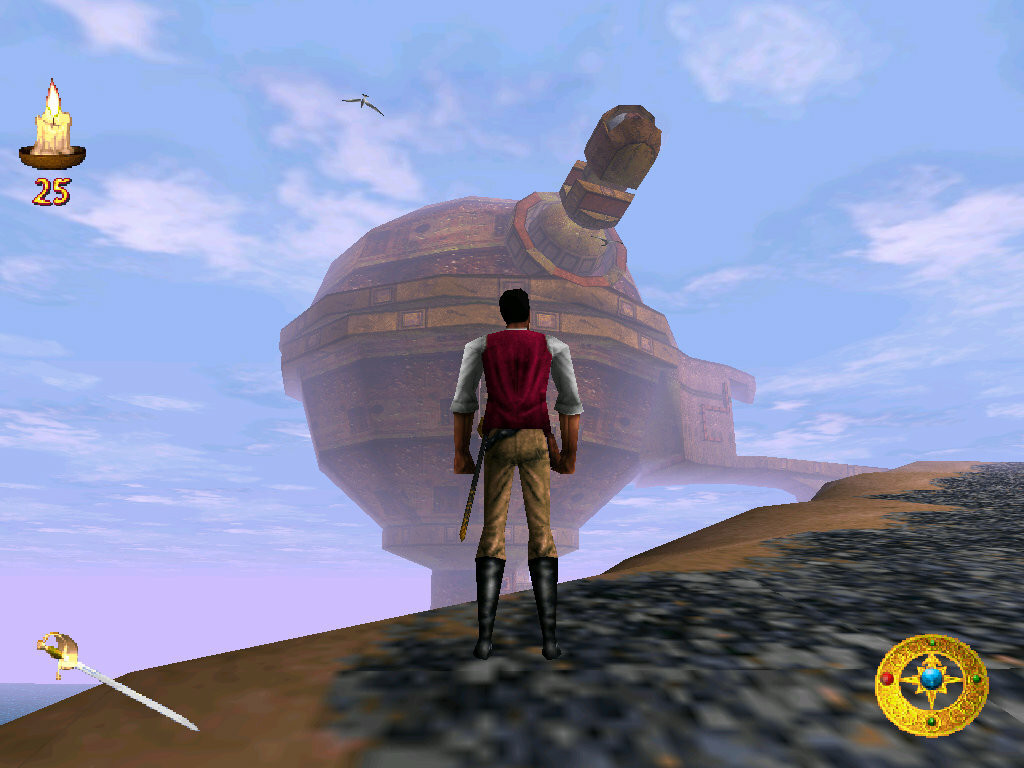
Redguard’s final confrontation takes place aboard a Dwemer airship above Stros M’Kai.
🌀 Sentinel in Daggerfall and the Warp in the West
The Third Era brought Sentinel its greatest triumph. The Elder Scrolls II: Daggerfall, set in 3E 405, takes place in the Iliac Bay, where dozens of small kingdoms compete for power. Sentinel was ruled at the time by Queen Akorithi, and the player can get deeply involved in its court politics.
The game’s many endings were later reconciled through an event known as the Warp in the West. Between the 9th and 11th of Frostfall in 3E 417, the struggle over the ancient Dwemer war machine Numidium reshaped the entire region. Where 44 city-states had existed before, only four powers remained: Sentinel, Wayrest, Daggerfall and Orsinium. Sentinel gained more land than any other, spreading across much of the southern Iliac Bay under Akorithi’s son, King Lhotun, who became one of the most powerful kings in Tamriel.
🔥 Hammerfell After the Great War: Why the Redguards Left the Empire
The Fourth Era is the part of Hammerfell lore that matters most for Sentinel. As early as 4E 42, Thalmor operatives attacked Altmer dissidents who had fled to Sentinel, destroying the city’s refugee district in what became known as the Night of Green Fire.
Then came the Great War. According to the in-game history The Great War, written by Legate Justianus Quintius, the Aldmeri Dominion delivered an ultimatum to Emperor Titus Mede II on the 30th of Frostfall, 4E 171. Among its demands was the surrender of large parts of Hammerfell. When the Emperor refused, Aldmeri armies invaded Cyrodiil and southern Hammerfell at the same time. The divided Redguards could only offer scattered resistance, and the outnumbered Imperial legions retreated across the Alik’r Desert in the famous March of Thirst. Of the southern cities, only the Crown city of Hegathe held out.
In early 4E 173, a Forebear army from Sentinel broke the siege of Hegathe, and the two rival factions finally reconciled. After the Empire’s victory at the Battle of the Red Ring, the war ended in 4E 175 with the White-Gold Concordat, which ceded a large part of southern Hammerfell to the Dominion. Hammerfell refused to accept it. To preserve the peace, Titus Mede II officially renounced Hammerfell as an Imperial province, a decision the Redguards saw as betrayal. They fought on alone for five more years, until the Second Treaty of Stros M’Kai in 4E 180 forced the Aldmeri to withdraw. Hammerfell emerged independent, but its south was devastated.
Skyrim shows the aftermath in small ways. In the quest In My Time of Need, a group of Alik’r warriors led by Kematu arrives in Whiterun hunting a Redguard woman named Saadia, whose real name is Iman. She claims she was a noble who spoke out against the Thalmor and had to flee. The Alik’r claim she betrayed the city of Taneth to the Aldmeri Dominion. The game never proves either side right and leaves the choice to you.
🔮 What Are the Elder Scrolls and the Moth Priests?
If the reported focus on the history of the Elder Scrolls holds true, Sentinel could dig into the series’ most mysterious artifacts. The Elder Scrolls are scrolls of unknown origin that record both past and future events. They cannot even be counted, as they seem to appear and disappear from place to place. Reading one without preparation can cost a person their sight or sanity.
That is why the Moth Priests of the Cult of the Ancestor Moth traditionally store and read them. Their ritual uses the Ancestor Moths to soften the Scrolls’ effect, but each reading still blinds them for a while, and over time their sight fades for good. Prophecies about the future can also change from reader to reader and from reading to reading. That makes Yazar’s words about a lost future and an undone victory especially intriguing. Speculation: fans are already debating whose victory might be undone, but Bethesda has not explained the inscription, and any theory about Sentinel’s plot is guesswork for now.
🎮 Hammerfell in Elder Scrolls Games
- The Elder Scrolls: Arena (1994): Hammerfell is one of the provinces you can visit, including Sentinel.
- The Elder Scrolls II: Daggerfall (1996): the Iliac Bay, Queen Akorithi’s Sentinel and the events behind the Warp in the West.
- The Elder Scrolls Adventures: Redguard (1998): Cyrus, Stros M’Kai and the end of the Redguard civil war.
- The Elder Scrolls Online (2014): the Alik’r Desert, Bangkorai, Stros M’Kai, Craglorn and Hew’s Bane during the Second Era.
- The Elder Scrolls V: Skyrim (2011): no visit, but the Great War, the Alik’r warriors and Hammerfell’s break with the Empire shape its world.
- The Elder Scrolls VI: Sentinel (TBA): developed by Bethesda Game Studios under Todd Howard on Creation Engine 3, with the reveal inscription dated 4E 206.
❓ Quick Questions About Hammerfell Lore
Is The Elder Scrolls VI set in Hammerfell?
All signs point to it. The game is named after a Hammerfell city, the reveal inscription is credited to a Moth Priest of Hammerfell’s High Queen, and The Verge reported the setting before the reveal.
When does The Elder Scrolls VI: Sentinel take place?
Bethesda has not given an exact timeframe, but the reveal inscription is dated 4E 206, five years after Skyrim.
Who are the Redguards?
The human people of Hammerfell, descended from the Yokudans who fled their sinking continent in the First Era. They are famous as Tamriel’s finest warriors.
What happened to Yokuda?
It sank around 1E 792. In-game sources blame natural disasters, a forbidden sword technique of the Hiradirge, or the wrath of Satakal.
Who founded Sentinel?
Grandee Yaghoub, the first Ra Gada to reach the Iliac Bay, who named the city after the watchman who spotted its harbor.
Why is Hammerfell not part of the Empire?
The Redguards rejected the White-Gold Concordat after the Great War, so Titus Mede II renounced the province. Hammerfell then drove out the Aldmeri on its own by 4E 180.
Final Words
Hammerfell is a land built by refugees and conquerors, shaped by a homeland lost to the sea, a people split between tradition and change, and a kingdom that chose independence over a peace it saw as surrender. With an Elder Scroll rising from the sand and a Moth Priest warning of a future lost, The Elder Scrolls VI: Sentinel is set up to explore all of it. Bethesda still has a lot to show, but the lore is already waiting. For more deep dives, read our Fallout timeline explained and our Warcraft lore explained.
Keep the adventure going! Check out more Gaming News on Gamersuniverse.
Picture Source: Bethesda Softworks (Name Reveal), Bethesda Softworks (2018 Teaser), Bethesda Softworks (Redguard)